Introduction to Circular Linked List (CLL)
A circular linked list is built from nodes and pointers. In a non-empty list, the last node does not leave a NULL “end”; its next points back into the list, forming a closed ring (commonly back to head). This lesson is the mental model for singly circular lists in C—structure, traversal discipline, and typical uses. Later CLL lessons cover insert, delete, and complexity.
- What “circular” means and how traversal behaves
- Ring diagram for
10 → 20 → 30 - Node struct, empty and one-node cases
- Use cases, pros & cons
1) What is a circular linked list?
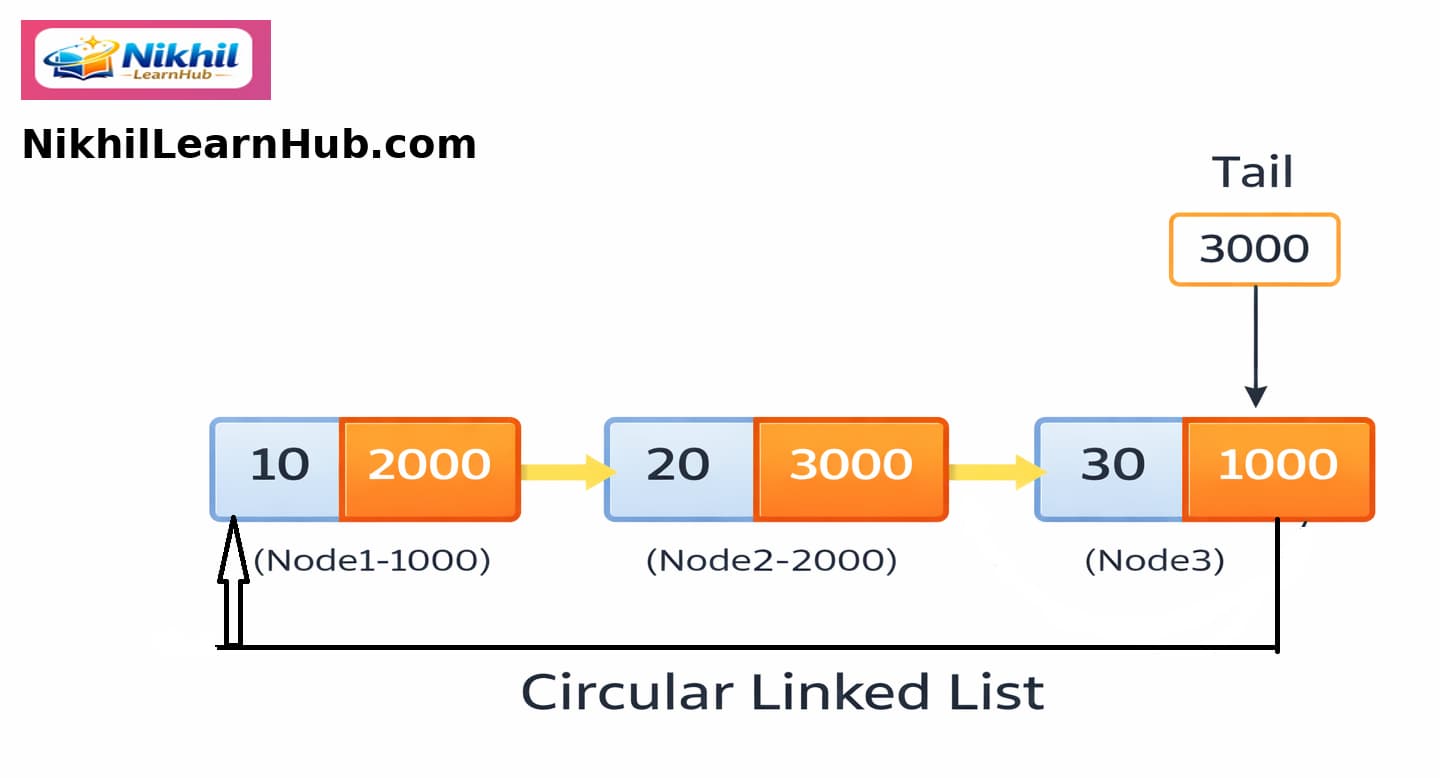
In a singly circular linked list, each node has data and one next pointer. In a non-empty list, no link is left dangling at NULL to mark “the end of the whole list”: the last node’s next points to some node in the ring—almost always the head. You still pick an entry point (usually head) for your API, but stepping next repeatedly will wrap around, so you must design loops with a clear stop rule (e.g. fixed count, or stop when you return to the node you started from).
The elements still form an ordered sequence around the ring; the defining property is closure: following next keeps you inside the same finite set of nodes.
Memory picture: circular chain
Example values 10 → 20 → 30 with last linking back to head:
CIRCULAR SLL (ring — last points back to head)
        ┌──────────────────────────────────┐
        │                                  │
        ▼                                  │
┌──────────────┐    ┌──────────────┐    ┌──────────────┐
│ data: 10     │    │ data: 20     │    │ data: 30     │
│ next: ───────┼───→│ next: ───────┼───→│ next: ───────┼──┐
└──────────────┘    └──────────────┘    └──────────────┘  │
     ▲ head (entry point) ◄──────────────────────────────┘
You still keep a designated head (and often a tail) in real code; the diagram shows logical closure of the ring.
2) What is a node in a CLL?
Each node holds data and a next pointer. Circularity does not require extra fields—it is enforced by how you set pointers: the last node’s next references another node in the list (typically head).
- Empty list:
head == NULL(no nodes—no ring). - Single node: that node’s
nextpoints to itself (a one-node ring).
Minimal singly linked node in C
struct Node {
    int data;
    struct Node *next;
};
See also Creating a Node and Types of Linked List in the main tutorial. Circular Linked List gives a shorter hub-style overview of variants.
3) Where circular lists help
Circularity is useful when work or access should wrap around naturally:
- Round-robin scheduling — processes or tasks take turns in a cycle.
- Queues implemented with a ring — fixed buffer or cyclic “next” through nodes.
- Multiplayer turn order — after the last player, the next turn returns to the first.
- Algorithms that rotate through a set — one pointer step moves you to the “next” in a repeating pattern.
4) Advantages of circular structure
- Uniform “next” — Every node has a valid successor; no special case for “after last” when iterating in a cycle.
- With a tail pointer — You can reach both last and first in O(1) (
tail->nextis oftenhead). - Good fit for cyclic workflows — Scheduling, turns, buffers that wrap.
5) Disadvantages and pitfalls
- Infinite loops — A naive
while (cur)never exits on a non-empty CLL; you need a stop condition. - More careful insert/delete — Breaking the ring or leaving a wrong link is easy; empty and single-node cases need explicit handling.
- Debugging — Cycles are harder to spot than a
NULLterminator (Floyd’s algorithm detects arbitrary cycles; here the whole list is the cycle by design).
Always pair CLL code with a clear plan for when to stop traversing and how to handle empty and single-node rings.
Key takeaway
A circular linked list is defined by closure: the chain has no NULL “end” in the non-empty case. You still use the same struct Node idea; discipline moves to keeping the ring consistent and terminating traversals safely.
Next up (CLL): Insert at Beginning (CLL) · Main linked list tutorial