Insert at Beginning
Inserting at the front of a singly linked list is O(1): create a node, set its next to the current head, then make that node the new head. Works when the list is empty (head == NULL) too.
C program (return new head)
The function returns the updated head pointer so main can write head = insert_begin(head, value);.
newNode->next = head;links the rest of the list (orNULLif list was empty).return newNode;makes the new node the head.
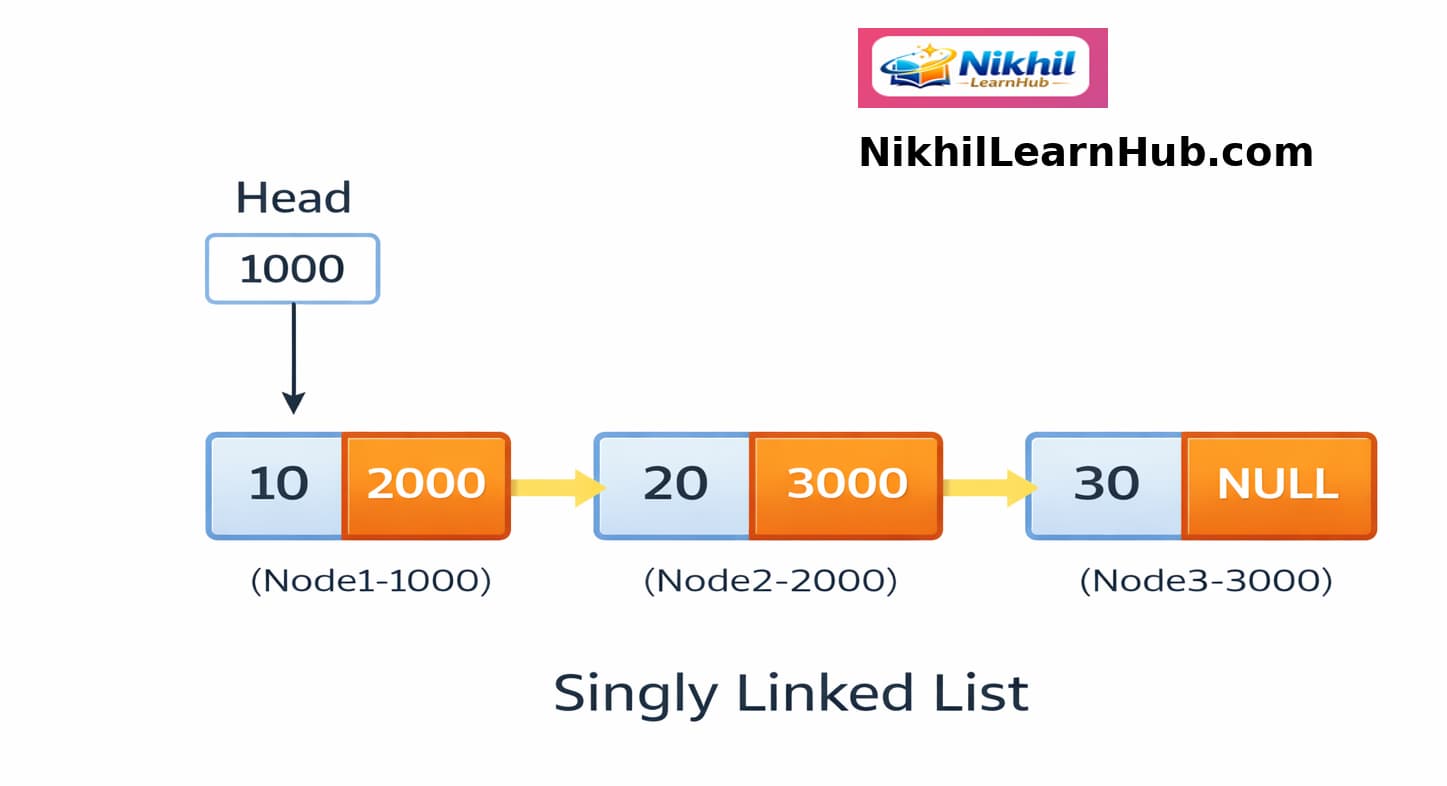
head — new node becomes the front.#include <stdio.h>
#include <stdlib.h>
struct Node {
int data;
struct Node *next;
};
struct Node *insert_begin(struct Node *head, int data)
{
struct Node *newNode = malloc(sizeof(struct Node));
if (newNode == NULL)
return head;
newNode->data = data;
newNode->next = head;
return newNode;
}
void print_list(struct Node *head)
{
struct Node *cur = head;
while (cur != NULL) {
printf("%d ", cur->data);
cur = cur->next;
}
printf("\n");
}
void free_list(struct Node *head)
{
struct Node *cur = head;
while (cur != NULL) {
struct Node *next = cur->next;
free(cur);
cur = next;
}
}
int main(void)
{
struct Node *head = NULL;
head = insert_begin(head, 30);
head = insert_begin(head, 20);
head = insert_begin(head, 10);
print_list(head); /* 10 20 30 */
free_list(head);
return 0;
}
Program output
Overall program flow
| Step | Operation | head points to |
List state (values) |
|---|---|---|---|
| 1 | head = NULL |
NULL |
Empty list |
| 2 | head = insert_begin(head, 30) |
Node with data 30 |
30 |
| 3 | head = insert_begin(head, 20) |
Node 20 → node 30 |
20 30 |
| 4 | head = insert_begin(head, 10) |
Node 10 → 20 → 30 |
10 20 30 |
| 5 | print_list(head) |
Same as step 4 | Output line: 10 20 30 |
| 6 | free_list(head) |
All nodes freed | List destroyed (no nodes left) |
Each insert_begin call in detail
Call 1: insert_begin(NULL, 30)
| Step | Operation | Variable | Value |
|---|---|---|---|
| 1 | Allocate new node | newNode | Address: 0x1000 |
| 2 | Set newNode->data | newNode->data | 30 |
| 3 | Set newNode->next | newNode->next | head (NULL) |
| 4 | Return newNode | return value | 0x1000 |
After call 1:
head → [30 | NULL]
Call 2: insert_begin(0x1000, 20)
| Step | Operation | Variable | Value |
|---|---|---|---|
| 1 | Allocate new node | newNode | Address: 0x2000 |
| 2 | Set newNode->data | newNode->data | 20 |
| 3 | Set newNode->next | newNode->next | head (0x1000) |
| 4 | Return newNode | return value | 0x2000 |
After call 2:
head → [20 | 0x1000] → [30 | NULL]
Call 3: insert_begin(0x2000, 10)
| Step | Operation | Variable | Value |
|---|---|---|---|
| 1 | Allocate new node | newNode | Address: 0x3000 |
| 2 | Set newNode->data | newNode->data | 10 |
| 3 | Set newNode->next | newNode->next | head (0x2000) |
| 4 | Return newNode | return value | 0x3000 |
After call 3:
head → [10 | 0x2000] → [20 | 0x1000] → [30 | NULL]
Memory layout (example addresses)
Final list in heap
| Address | Node | data |
next |
Points to |
|---|---|---|---|---|
0x3000 |
n1 (newest insert) |
10 | 0x2000 |
n2 |
0x2000 |
n2 |
20 | 0x1000 |
n3 |
0x1000 |
n3 (first insert) |
30 | NULL |
nowhere |
Visual representation
head (0x3000)
   │
   ▼
┌──────────────┐    ┌──────────────┐    ┌──────────────┐
│ data: 10     │    │ data: 20     │    │ data: 30     │
│ next: 0x2000 ┼───→│ next: 0x1000 ┼───→│ next: NULL   │
└──────────────┘    └──────────────┘    └──────────────┘
     n1                   n2                   n3
  (inserted last)     (inserted 2nd)      (inserted first)
Detailed step-by-step: call 3 (insert 10)
Inside insert_begin when head is 0x2000 and data is 10:
| Line | Code | Before | After |
|---|---|---|---|
| 1 | malloc(sizeof(struct Node)) |
— | Heap block at 0x3000; newNode = 0x3000 |
| 2 | if (newNode == NULL) |
newNode = 0x3000 (not NULL) |
Skip return head |
| 3 | newNode->data = data; |
newNode->data uninitialized |
newNode->data = 10 |
| 4 | newNode->next = head; |
head passed in = 0x2000 |
newNode->next = 0x2000 |
| 5 | return newNode; |
Return value 0x3000 |
In main: head = 0x3000 |
Complexity summary
| Operation | Time | Extra space |
|---|---|---|
insert_begin |
O(1) |
O(1) for the one new node |
print_list |
O(n) |
O(1) |
free_list |
O(n) |
O(1) |
| Whole program (build + print + free) | O(n) |
O(n) nodes stored in the list |
The key takeaway is that inserting at the beginning of a linked list is O(1) time: you only allocate one node and update the head pointer, no matter how long the list already is.
Alternative: pass struct Node **head and update *head inside the function—same logic, no return value needed.