Stack and recursion
When a function calls another function (including itself), the runtime uses a region of memory called the call stack. Each active call gets a stack frame that is pushed when the call starts and popped when the call returns. Recursion is simply a chain of such frames for the same function name, each with its own copy of parameters and local variables. The stack is LIFO: the call that started last must finish before the one below it can resume—exactly the “unwind” you see when a base case returns.
- Call stack — frames, push on call, pop on return
- Recursion — many frames, one function
- Example — factorial
fact(n)in C - Limits — depth and stack overflow
1) What the call stack stores
Each stack frame (activation record) typically holds enough information for one invocation of a function, for example:
| Item | Role |
|---|---|
| Return address | Where to continue after this call finishes. |
| Parameters | Values passed into this call (e.g. n). |
| Local variables | Storage used only inside this call. |
| Saved registers / bookkeeping | Details the compiler and ABI require (often hidden from source code). |
You do not manage this stack by hand in normal C code—the CPU and compiler do. Conceptually, though, it behaves like the abstract stacks you implement with arrays or lists: call ≈ push, return ≈ pop.
2) How recursion uses the stack
Recursive functions have a base case (stop recursing) and a recursive case (call itself with simpler input).
- Each time the recursive case runs, a new frame is pushed for the same function with a new parameter (e.g. smaller
n). - When the base case runs, it returns immediately; that frame is popped and control returns to the caller, which may multiply or combine results and then return in turn.
- The maximum depth of the call stack equals the longest chain of unfinished calls—often the recursion depth.
If recursion is too deep for the fixed call-stack size, the program can crash with stack overflow. That is why some algorithms are rewritten iteratively with an explicit stack in the heap, or converted to a loop when possible.
3) Example: factorial in C
Mathematically n! = n × (n−1) × … × 1, with 0! = 1. The recursive definition is n! = n × (n−1)! for n > 0. Each call to fact(n) waits for fact(n-1) to return—so each waiting call occupies a frame on the call stack.
#include <stdio.h>

/* Each call pushes a frame with its own n until n <= 1. */
long long fact(int n) {
    if (n <= 1)
        return 1;
    return (long long)n * fact(n - 1);
}

int main(void) {
    int n = 4;
    printf("%d! = %lld\n", n, fact(n));
    return 0;
}
For large n, recursion depth grows linearly with n; use an iterative loop or a wider type if values overflow long long. Compilers may optimize some recursions (e.g. tail recursion) only in specific cases.
Call-stack picture for fact(4)
Frames are listed bottom → top (top is the most recently entered call). When a row says “return”, that frame is popped and the value is passed back to the caller.
| Phase | What happens | Active frames (bottom → top) |
|---|---|---|
| Grow | main calls fact(4), which calls fact(3) … down to fact(1). |
main → fact(4) → fact(3) → fact(2) → fact(1) |
| Base | fact(1) hits n <= 1, returns 1 (pop fact(1)). |
main → fact(4) → fact(3) → fact(2) |
| Unwind | fact(2) returns 2 × 1 = 2; then fact(3) returns 6; fact(4) returns 24. |
Frames pop one by one until only main remains. |
The last call to start (fact(1)) is the first to finish—classic LIFO stack behavior.
Key points
| Idea | Explanation |
|---|---|
| Stack = pending work | Each frame is a function call that is waiting for a callee to return. |
| Recursion depth | Deep recursion uses many frames; the OS/runtime limits stack size. |
| Same idea elsewhere | Explicit stacks mimic recursion for DFS, tree traversals, and undo—see Stack applications. |
4) Trade-offs
- Pros — Recursive code can match mathematical definitions closely; the call stack handles saving state automatically.
- Cons — Stack space per frame; risk of overflow; sometimes slower than a tight loop due to call overhead.
Background on the abstract stack ADT: Stack introduction · Stack using array.
5) What the stack does here
Every time fact(n) is called, the system:
- Creates a stack frame (activation record).
- Stores in that frame, among other things:
- The value of
nfor this call. - The return address (where to resume after this call returns).
- Room for the partial computation—e.g. each caller is waiting to finish
n × (result offact(n−1)).
- The value of
This follows LIFO (Last In, First Out): the most recently called function returns first.
Step-by-step execution (n = 4)
Function calls (PUSH operations)
fact(4)
 → fact(3)
   → fact(2)
     → fact(1)
At this point, the call stack looks like (top = most recent):
TOP
fact(1)
fact(2)
fact(3)
fact(4)
BOTTOM
Each call is waiting for the result of the next (inner) call.
Returning phase (POP operations)
Now execution reverses:
fact(1)returns1fact(2)→2 × 1 = 2fact(3)→3 × 2 = 6fact(4)→4 × 6 = 24
The stack shrinks as each frame is discarded:
- POP
fact(1) - POP
fact(2) - POP
fact(3) - POP
fact(4)
After fact(1) returns, the active chain is main → fact(4) → fact(3) → fact(2); each return removes one frame until fact(4) finally returns to main.
Visualization
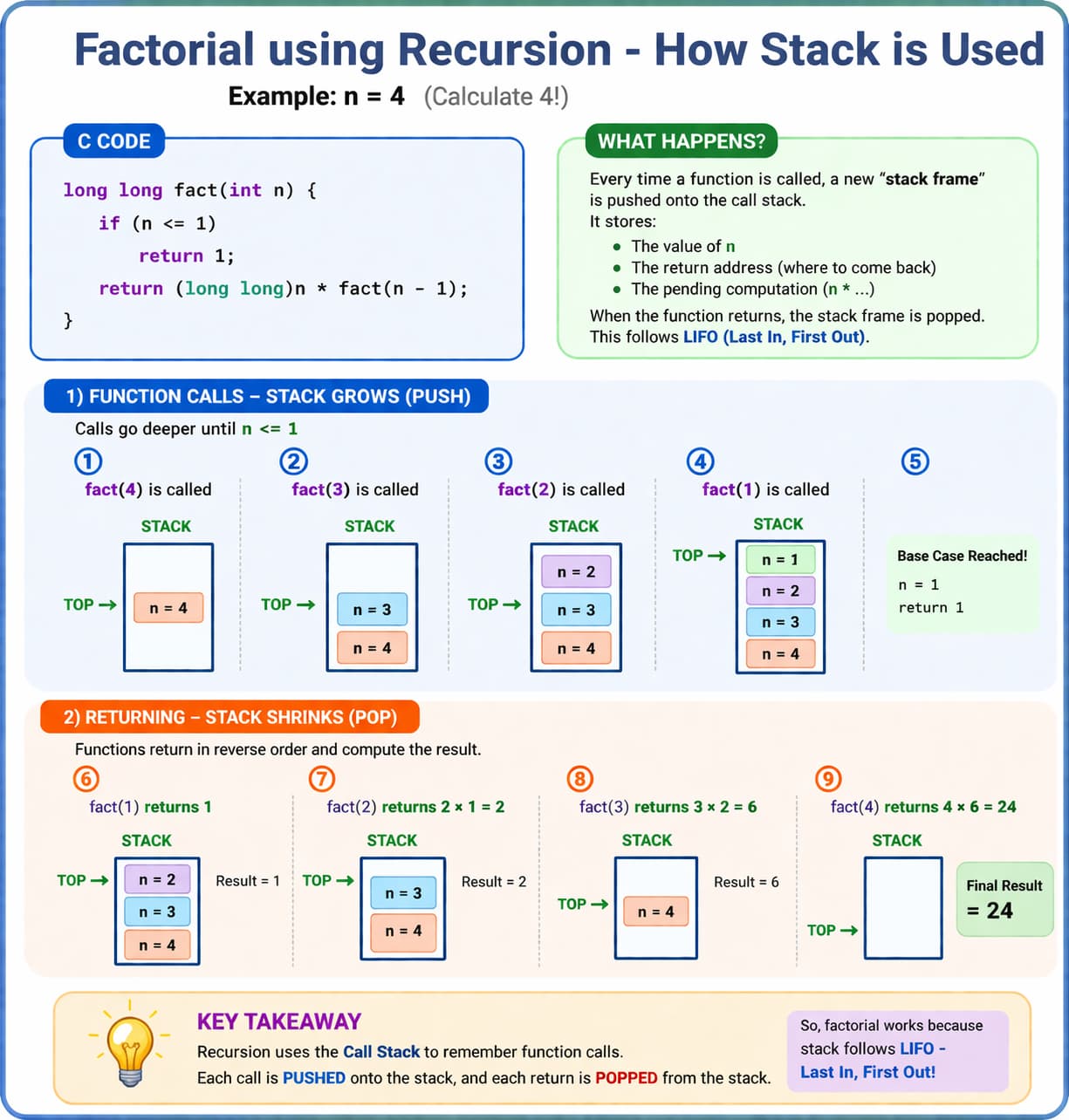
fact(n) (e.g. n = 4).During calls (stack growing)
| fact(4) |
| fact(3) |
| fact(2) |
| fact(1) | ← Top
During returns (stack shrinking)
| fact(4) | ← Last among recursive calls to finish (then returns to main)Earlier in the unwind, more frames are still present (e.g. right after fact(1) returns, the top frame is fact(2)); the diagram above highlights that fact(4) is the outermost recursive frame and completes last.
Key concept for students
“Each recursive call is pushed onto the stack, and execution resumes in reverse order when returning.”
Key takeaway
Recursion is implemented with a call stack: every recursive call pushes a new frame; every return pops it. Understanding that stack explains execution order, memory use, and why infinite recursion overflows the stack.
See also: Stack applications · Stack tutorial