Strong problem-solving skills help in coding interviews, competitive programming, and coursework. This page follows a clear sequence: understand the problem (inputs, outputs, constraints), strengthen mathematics and logic, master one programming language, design and verify logic with multiple test cases, then implement a clean solution. Use the infographic below as a map, then read each step in detail.
Five steps in order
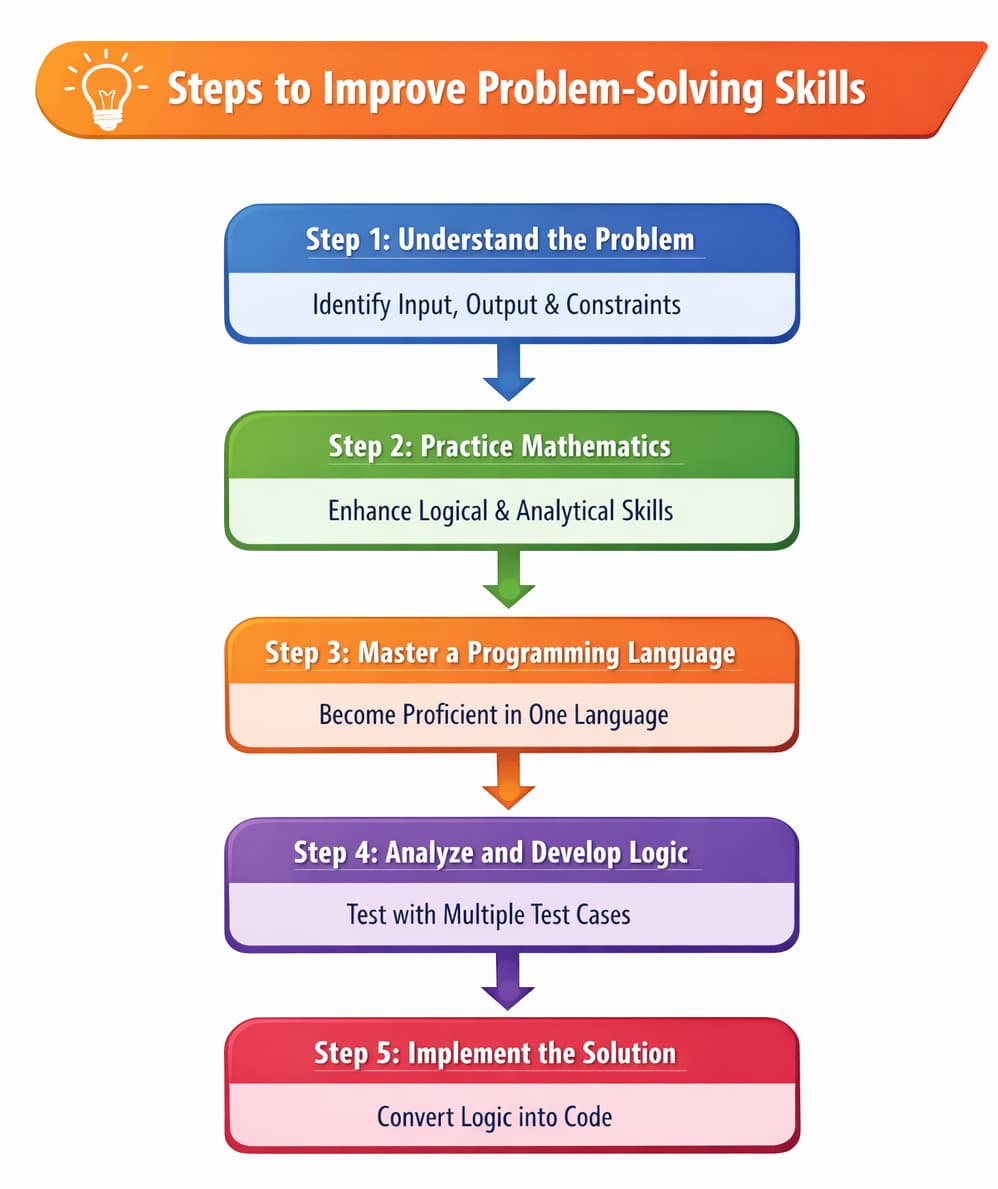
Work through these steps in order. Skipping ahead often leads to wasted time on the wrong approach or buggy code.
Steps in detail
- Understand the Problem Identify input, output & constraints Before writing code, restate what is asked. List expected inputs and outputs, note limits (array size, value ranges, time/memory), and clarify edge cases. See also Engineers Hub — problem solving.
- Practice Mathematics Enhance logical & analytical skills Discrete math, combinatorics, and basic number theory often underpin algorithms. Strengthen reasoning so you can pick the right model for a problem.
- Master a Programming Language Become proficient in one language Know syntax, standard libraries, I/O, and debugging in one language deeply before spreading thin. Programming languages hub
- Analyze and Develop Logic Test with multiple test cases Trace your approach on paper or with examples; include edge cases (empty input, single element, max values). Refine until the logic holds before coding.
- Implement the Solution Convert logic into code Write readable code, match your verified logic, and run against your test cases. For more practice patterns, visit the problem solving hub and overview.