Learning programming languages gets easier when you follow a sequence: build fundamentals, prepare for exams and interviews, strengthen logic with problem-solving programs, and finally ship real-world projects. Use the infographic below as a map, then read each stage in detail.
Four stages in order
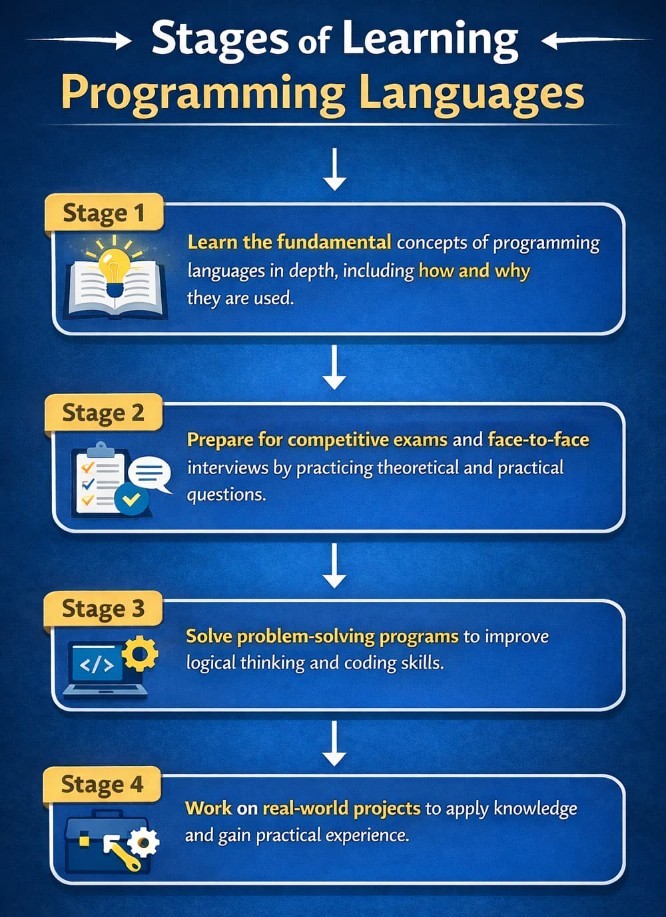
Go stage by stage. Each stage builds the knowledge needed for the next—so you avoid gaps, confusion, and “random practice.”
Stages in detail
- Stage 1 — Learn the fundamentals Understand what the language is for and why it works Study syntax, core concepts, tooling, and debugging. For tracks and practice ideas, use the programming languages hub.
- Stage 2 — Prepare for exams & interviews Practice theoretical + practical questions Solve interview-style questions and revise key topics. Start with the interview questions hub.
- Stage 3 — Improve with problem-solving programs Build logical thinking through coding Practice structured problems (easy → medium → hard). This strengthens reasoning and implementation speed. See the problem solving hub.
- Stage 4 — Work on real-world projects Apply knowledge and gain practical experience Ship projects with real constraints (APIs, databases, testing, deployment). For project direction, explore the full stack hub.