Time Travel Trouble
Story Summary
When Lily accidentally activates her scientist parents' time machine, she must fix the timeline before history changes forever
This science fiction story is perfect for bedtime reading, classroom storytelling, and family discussions. Ages 5–12.
What Kids Learn
- Imagination: What-if stories spark creative thinking.
- Science ideas: Space, robots, and time travel use real science questions.
- Empathy: Even robots and aliens can teach feelings.
- Teamwork: Crews and friends solve big problems together.
- Curiosity: Asking how and why leads to discovery.
Before you read the full story, meet the characters of Time Travel Trouble. This science fiction story helps children enjoy reading while learning values and new ideas.
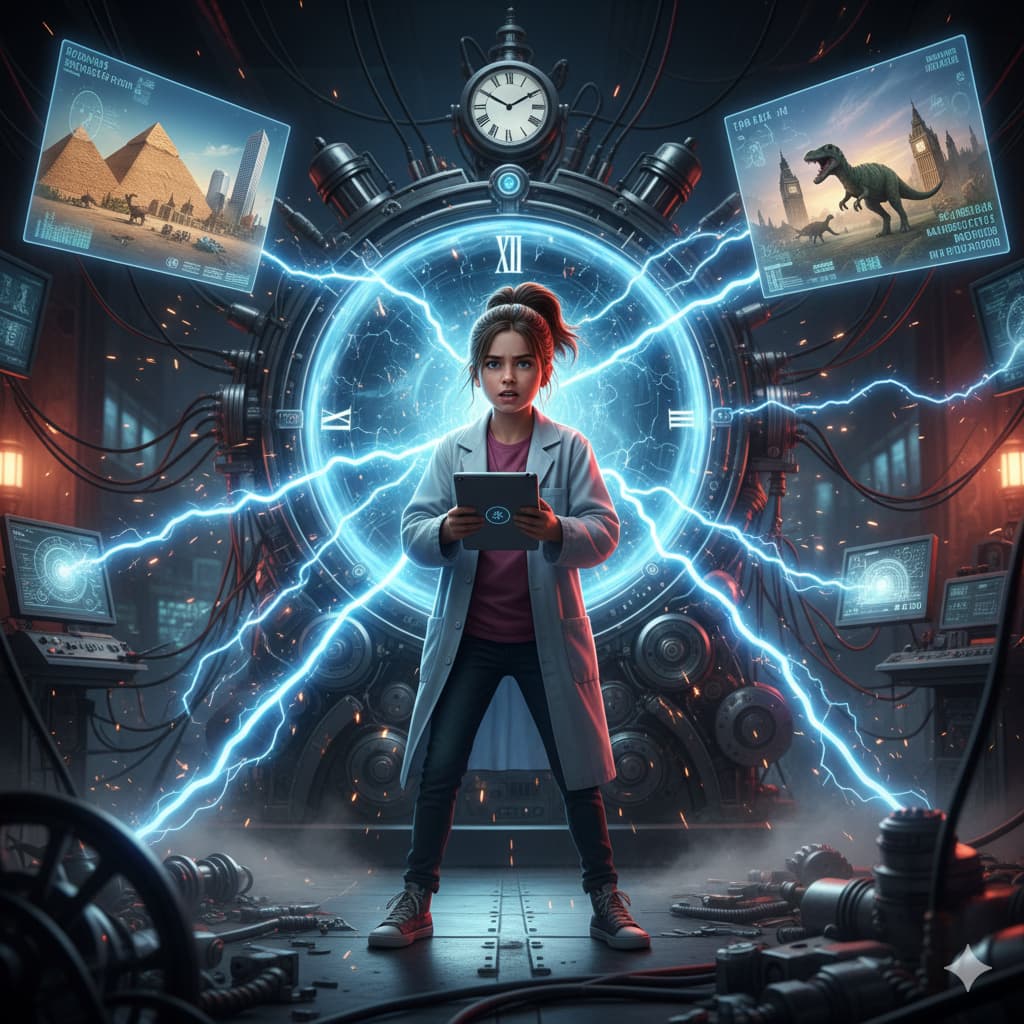
Time Travel Team
Lily - The Accidental Time Traveler
A curious 10-year-old who loves exploring her scientist parents' lab. Her curiosity leads to a time travel adventure she never expected.
Leo - The History Expert
Lily's older brother who knows everything about history. He becomes crucial in helping fix the timeline when things go wrong.
TIM - Time Interface Module
The AI assistant in the time machine that helps navigate through time but warns about the dangers of changing history.
Dr. & Dr. Chen - The Scientist Parents
Lily's parents who created the time machine. They're away at a conference when the trouble begins.
The Time Travel Adventure
Chapter 1: The Accidental Activation
Narrator: Lily's parents had one rule: Never touch anything in the lab. But on a quiet Saturday afternoon, while her parents were at a science conference, Lily's curiosity got the better of her.
Narrator: The time machine - a shimmering metallic ring with glowing blue lights - looked like something from a movie. Lily just wanted to see what would happen if she pressed the big red button.
Time Travel Fact
Scientists believe time travel to the future might be possible through time dilation (traveling at near light-speed), but traveling to the past raises many paradox questions like the "grandfather paradox"!
"Just one little press... What's the worst that could happen?"
The Butterfly Effect
The butterfly effect means that small changes in the past can have huge consequences in the present. Even moving a single pebble could change history forever!
The First Mistake
Narrator: Lily found herself in 1920, in the middle of a busy city street. Surprised by a honking car, she jumped back and accidentally knocked over a fruit cart. The owner chased after her, but Lily quickly pressed her time machine bracelet and returned to the present.
"Warning: Temporal disturbance detected. Historical event altered. The fruit cart incident has created a ripple effect."
The First Consequence
Narrator: When Lily returned to the present, something was wrong. Her house looked different - the color was wrong, the trees were gone, and worst of all, her dog Sparky didn't exist!
Narrator: She ran to her brother Leo's room. He was still there, but he didn't remember Sparky at all.
"Lily, what's wrong? And why are you wearing that weird bracelet? Wait... you didn't touch the time machine, did you?"
"Analysis: The fruit cart owner was your great-great-grandfather. By knocking over his cart, you changed his life path. He never met your great-great-grandmother. Sparky was never born because your family line changed."
"Oh no! What have I done? We have to fix this! But how do we fix history without making things worse?"
The Repair Mission
Never change what already happened.
Rule #2: Fix only what you broke."
Narrator: Leo explained that they couldn't just prevent Lily from knocking over the cart - that would create a time paradox. Instead, they had to fix the consequences after they happened.
"We need to go back to 1920, but not to the exact moment you were there. We need to find another way to make sure our great-great-grandparents still meet."
The Historical Research
Narrator: Leo pulled out old family albums and history books. He discovered that their great-great-grandparents were supposed to meet at a town festival two weeks after the fruit cart incident.
"Calculating temporal coordinates. The town festival of 1920 begins in two weeks from your original arrival point. But remember: You must not be seen. You are fixing a problem, not creating a new one."
"I understand now. Every action has consequences. I was curious and didn't think about what could happen. Now I have to fix it."
The Festival Fix
Narrator: Lily and Leo arrived at the 1920 town festival in old-fashioned clothes that TIM had created. They had to be invisible helpers - making sure their great-great-grandfather and great-great-grandmother were in the right place at the right time.
Narrator: When a sudden rainstorm threatened to ruin the festival, Lily had an idea. She "accidentally" knocked over a sign that led both ancestors to take shelter in the same gazebo.
Returning Home
Narrator: When Lily and Leo returned to the present, everything was back to normal. The house was the right color, the trees were back, and best of all, Sparky came running to greet them, wagging his tail happily.
"Sparky! You're back! Oh, I'm so sorry I almost made it so you were never born. I'll never touch something I'm not supposed to again!"
The Important Lesson
Narrator: When their parents returned from the conference, Lily confessed everything. Instead of being angry, they were impressed with how she and Leo had worked together to fix the problem.
"Lily, we're not happy you broke the rules, but we're very proud that you took responsibility and fixed your mistake. That's the most important lesson about science - and about life."
"I learned that every action has consequences, even small ones. And when we make mistakes, we should try to fix them instead of running away. Curiosity is good, but responsibility is important too."
"And I learned that history is like a delicate web. Touch one thread, and the whole web shakes. We have to be careful with our actions because they can affect more than just ourselves."
Moral of the Story
Every action has consequences, and taking responsibility is important. Curiosity is wonderful, but it should be paired with careful thinking about what might happen. When we make mistakes, we should own up to them and try to fix them. Our actions affect not just us, but people around us and sometimes even history itself!
Discussion Points
Talk with your child about times when their actions had unexpected consequences. Discuss the difference between curiosity and responsibility. Ask: "Have you ever had to fix a mistake you made? How did it feel?" Explore the concept of cause and effect with simple examples from daily life. Discuss why rules exist and the importance of thinking before acting.
Kids Activities
- Draw a spaceship, robot, or futuristic scene.
- Invent one new gadget for the story world.
- Write what you would ask an alien or robot.
- Retell the story as a comic strip.
- Name three science topics to explore after reading.