C Dynamic Memory Allocation - Complete Guide
Master C dynamic memory allocation including static vs dynamic memory, malloc, calloc, realloc, free functions, memory management techniques, and programming best practices.
Static vs Dynamic
Memory comparison
4 Functions
malloc, calloc, realloc, free
Memory Errors
Leaks, dangling pointers
Best Practices
Safe memory management
Introduction to Dynamic Memory Allocation
Dynamic memory allocation allows programs to request memory at runtime rather than compile time. This enables flexible data structures that can grow or shrink as needed, efficient memory usage, and handling of data whose size is unknown at compile time.
Why Dynamic Memory Matters
- Runtime Flexibility: Allocate memory as needed during execution
- Efficient Memory Usage: Use only what you need
- Data Structures: Essential for linked lists, trees, graphs
- Unknown Size: Handle data of unpredictable size
- Large Data: Allocate memory beyond stack limits
- Shared Memory: Create memory that persists beyond function calls
Memory Allocation Functions
- malloc(): Allocate raw memory block
- calloc(): Allocate and zero-initialize
- realloc(): Resize existing allocation
- free(): Release allocated memory
- Memory Leak: Allocated memory not freed
- Dangling Pointer: Pointer to freed memory
malloc, calloc, and realloc, with free to release memory and avoid leaks.Core Concepts of Dynamic Memory
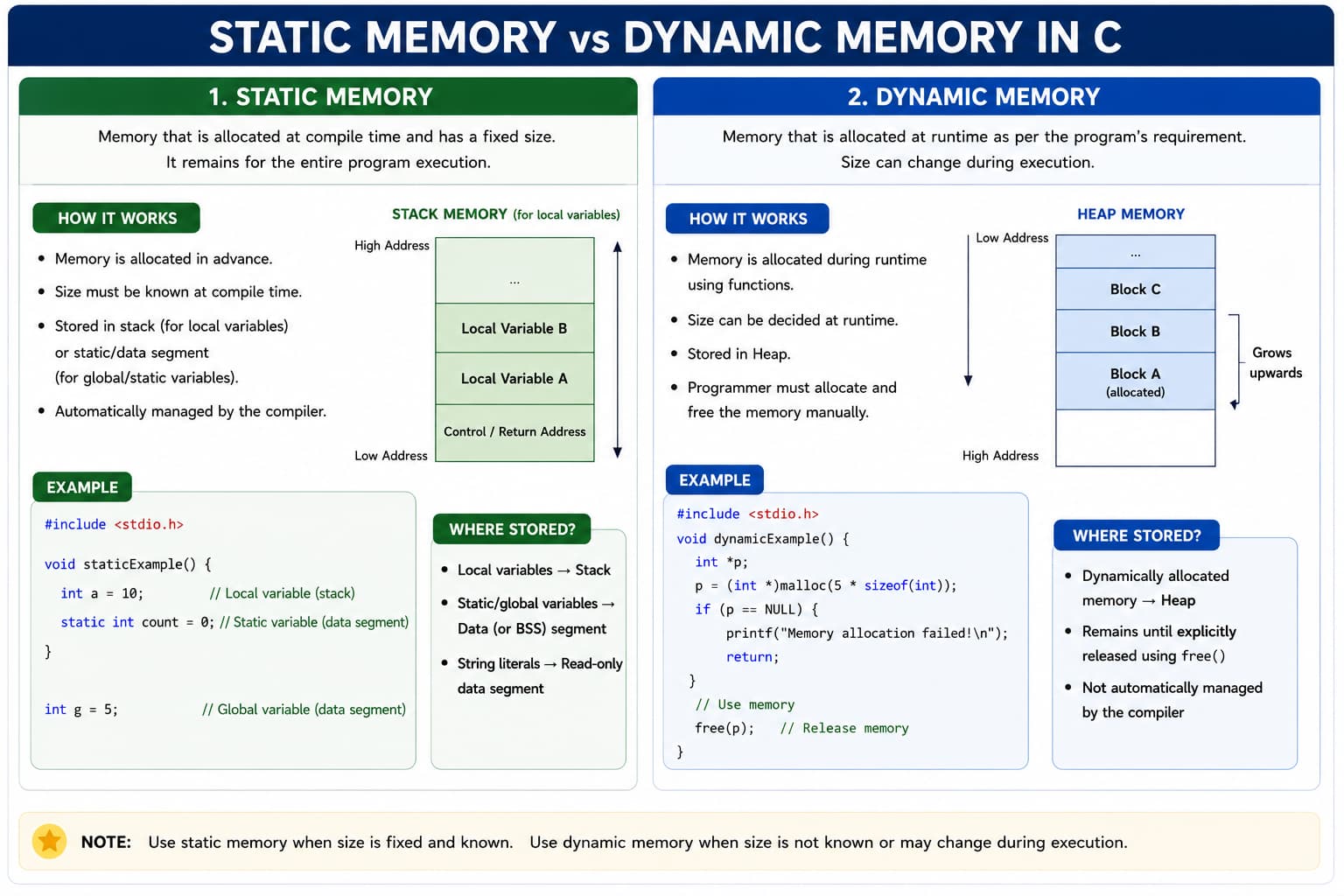
Dynamic memory is allocated from the heap segment, managed manually by the programmer. Every malloc/calloc must have a corresponding free. The heap grows upward, while the stack grows downward. Understanding this memory model is crucial for preventing memory errors and writing efficient programs.
Static vs Dynamic Memory Comparison
Here is a comprehensive comparison of static and dynamic memory allocation in C:
| Feature | Static Memory Allocation | Dynamic Memory Allocation |
|---|---|---|
| Allocation Time | Compile time | Runtime |
| Memory Segment | Stack/Data segment | Heap segment |
| Size Determination | Fixed at compile time | Determined at runtime |
| Lifetime | Automatic (function scope) or Program duration | Until explicitly freed |
| Management | Automatic by compiler | Manual by programmer |
| Speed | Faster (compile-time) | Slower (runtime overhead) |
| Flexibility | Fixed size | Can grow/shrink |
| Risk | Stack overflow if too large | Memory leaks if not freed |
| Usage | Small, known-size data | Large, variable-size data |
| Example | int arr[100]; |
int *arr = malloc(100*sizeof(int)); |
Memory Segments Visualization:
Code Segment
Program instructionsData Segment
Static/Global variablesHeap Segment
Dynamic memory (grows upward)Stack Segment
Local variables (grows downward)malloc() Function - Complete Guide
The malloc() (memory allocation) function allocates a block of memory of specified size in bytes and returns a pointer to the beginning of the block. The allocated memory contains garbage values (uninitialized).
Syntax:
void* malloc(size_t size);
Parameters: size - Number of bytes to allocate
Return Value: Pointer to allocated memory, or NULL if allocation fails
Key Characteristics:
- Uninitialized Memory: Contains garbage values (random data)
- Return Type:
void*(generic pointer) - requires casting - NULL Check: Always check if malloc returns NULL
- Size Calculation: Use
sizeof()operator for portability - Memory Alignment: Returns memory aligned for any data type
- Heap Allocation: Memory comes from heap segment
Memory Lifecycle Visualization:
malloc() Examples:
#include <stdio.h>
#include <stdlib.h>

int main(void) {
    int *p = (int *)malloc(sizeof(int));
    if (!p) return 1;
    *p = 42;
    printf("%d\n", *p);
    free(p);
    return 0;
}42
- Always include
<stdlib.h> - Always check if malloc returns
NULL - Use
sizeof()for correct size calculation - Cast the return value to appropriate type
- Initialize memory before use (contains garbage)
- Always call
free()when done - Set pointer to
NULLafterfree() - Don't call
free()on non-malloc memory
#include <stdio.h>
#include <stdlib.h>

int main(void) {
    int n = 5, i;
    int *arr = (int *)malloc(n * sizeof(int));
    if (!arr) return 1;
    for (i = 0; i < n; i++) arr[i] = i * 10;
    printf("%d\n", arr[2]);
    free(arr);
    return 0;
}
calloc() Function - Complete Guide
The calloc() (contiguous allocation) function allocates memory for an array of elements, initializes all bytes to zero, and returns a pointer to the memory. It's ideal for arrays and structures that need zero initialization.
Syntax:
void* calloc(size_t num, size_t size);
Parameters: num - Number of elements, size - Size of each element in bytes
Return Value: Pointer to allocated memory (all bits zero), or NULL if allocation fails
Key Characteristics:
- Zero-Initialized: All bits set to zero (0 for integers, 0.0 for floats, NULL for pointers)
- Two Parameters: Takes number of elements and size of each element
- Array-Oriented: Designed for allocating arrays
- Slower than malloc: Extra overhead for zero initialization
- Memory Calculation: Total memory = num × size bytes
- Safer: Zero initialization prevents garbage values
calloc() vs malloc() Comparison:
| Feature | malloc() | calloc() |
|---|---|---|
| Parameters | 1 (total bytes) | 2 (count, element size) |
| Initialization | Garbage values | All bits zero |
| Speed | Faster | Slower (initialization overhead) |
| Use Case | General allocation | Arrays, need initialization |
| Syntax Example | malloc(10 * sizeof(int)) |
calloc(10, sizeof(int)) |
| Memory Content | Unpredictable | Predictable (zeros) |
calloc() Examples:
#include <stdio.h>
#include <stdlib.h>

int main(void) {
    int *arr = (int *)calloc(5, sizeof(int));
    if (!arr) return 1;
    arr[0] = 10;
    printf("%d (rest are 0)\n", arr[0]);
    free(arr);
    return 0;
}
calloc() not only sets memory to zero but also ensures memory is "clean" from any previous data. This is particularly important for security-sensitive applications where leftover data in memory could be a security risk. Additionally, some operating systems implement calloc() using lazy allocation, where physical memory isn't actually allocated until it's written to.
realloc() Function - Complete Guide
The realloc() (reallocate) function changes the size of a previously allocated memory block. It can expand or shrink the allocation while preserving existing data (as much as possible).
Syntax:
void* realloc(void* ptr, size_t new_size);
Parameters: ptr - Pointer to previously allocated memory, new_size - New size in bytes
Return Value: Pointer to reallocated memory (may be different), or NULL if allocation fails
Key Characteristics:
- Size Change: Can increase or decrease allocation size
- Data Preservation: Preserves existing data up to minimum of old and new size
- Pointer May Change: May return different pointer address
- NULL Pointer: If ptr is NULL, realloc() behaves like malloc()
- Zero Size: If new_size is 0 and ptr is not NULL, memory is freed
- Performance: May need to copy data if can't expand in place
realloc() Behavior Scenarios:
| Scenario | realloc() Behavior | Result |
|---|---|---|
| ptr is NULL | Acts like malloc(new_size) | New allocation |
| new_size is 0 | Acts like free(ptr) | Memory freed, returns NULL |
| Enough space after block | Extends in place | Same pointer, larger size |
| Not enough space after | Allocates new block, copies data, frees old | New pointer, old data copied |
| Smaller new_size | Shrinks block (may free excess) | Same pointer, smaller size |
| Allocation fails | Returns NULL, original block unchanged | Need to handle failure |
realloc() Examples:
#include <stdio.h>
#include <stdlib.h>

int main(void) {
    int *p = (int *)malloc(2 * sizeof(int));
    if (!p) return 1;
    p[0] = 1; p[1] = 2;
    p = (int *)realloc(p, 4 * sizeof(int));
    if (!p) return 1;
    p[2] = 3; p[3] = 4;
    printf("%d %d %d %d\n", p[0], p[1], p[2], p[3]);
    free(p);
    return 0;
}- Always use temporary variable:
new_ptr = realloc(old_ptr, size) - Check if realloc returns
NULLbefore assigning - If realloc fails, original pointer is still valid
realloc(NULL, size)behaves likemalloc(size)realloc(ptr, 0)behaves likefree(ptr)- When expanding, new memory area is uninitialized
- When shrinking, excess memory is freed (data may be lost)
- Pointer may change address - update all references
free() Function - Complete Guide
The free() function deallocates memory previously allocated by malloc(), calloc(), or realloc(). It returns the memory to the heap for reuse. Proper memory deallocation is crucial to prevent memory leaks.
Syntax:
void free(void* ptr);
Parameters: ptr - Pointer to memory block to free
Return Value: None (void)
Key Characteristics:
- Memory Deallocation: Returns memory to heap
- No Return Value: Function returns void
- NULL Safe:
free(NULL)does nothing (safe to call) - Dangling Pointers: Pointer becomes invalid after free()
- Memory Leak: Forgetting to free() causes memory leak
- Double Free: Calling free() twice on same pointer causes undefined behavior
- Heap Corruption: Freeing non-heap memory or corrupted pointers
Memory Leak Visualization:
Memory Leak Over Time
Memory blocks that are allocated but never freed become leaks, reducing available memory over time
free() Examples:
#include <stdio.h>
#include <stdlib.h>

int main(void) {
    int *p = (int *)malloc(sizeof(int));
    if (!p) return 1;
    *p = 99;
    free(p);
    p = NULL;
    printf("freed and set to NULL\n");
    return 0;
}- Pair Allocation with Free: Every malloc/calloc should have a corresponding free
- Set to NULL After Free: Prevents dangling pointer errors
- Free in Reverse Order: For nested structures, free inner allocations first
- Use Memory Debuggers: Valgrind, AddressSanitizer to catch leaks
- Document Ownership: Clearly indicate who allocates and who frees
- Check Return Values: Always check if allocation functions succeed
- Avoid Memory Fragmentation: Reuse allocations when possible
- Use RAII Patterns: In C++, use constructors/destructors for automatic cleanup
Common Memory Errors and Solutions
Memory management errors are among the most common and difficult-to-debug issues in C programming. Understanding these errors and their solutions is crucial for writing robust programs.
Memory Error Prevention Strategies:
- Use Memory Debuggers: Valgrind, AddressSanitizer, Electric Fence
- Code Reviews: Have others review memory management code
- Static Analysis: Use tools like Coverity, Clang Analyzer
- Defensive Programming: Add asserts and sanity checks
- Memory Pools: For performance-critical code with fixed-size allocations
- RAII Patterns: In C++, use smart pointers (unique_ptr, shared_ptr)
- Testing: Write tests that stress memory usage
- Documentation: Clearly document memory ownership
- Avoid Manual Memory When Possible: Use standard containers in C++
- Educate Team: Ensure all team members understand memory management
# Compile: gcc -g program.c -o program
# Run:     valgrind --leak-check=full ./program

#include <stdio.h>
#include <stdlib.h>

int main(void) {
    int *p = malloc(sizeof(int));
    *p = 1;
    free(p);
    return 0;
}==12345== Memcheck, a memory error detector
==12345== Copyright (C) 2002-2017, and GNU GPL'd, by Julian Seward et al.
==12345== Using Valgrind-3.13.0 and LibVEX; rerun with -h for copyright info
==12345== Command: ./test
==12345==
Testing memory errors...
Test completed.
==12345==
==12345== HEAP SUMMARY:
==12345== in use at exit: 400 bytes in 1 blocks
==12345== total heap usage: 1 allocs, 0 frees, 400 bytes allocated
==12345==
==12345== 400 bytes in 1 blocks are definitely lost in loss record 1 of 1
==12345== at 0x4C2DB8F: malloc (in /usr/lib/valgrind/vgpreload_memcheck-amd64-linux.so)
==12345== by 0x1086B1: memory_leak_example (test.c:6)
==12345== by 0x108721: main (test.c:24)
==12345==
==12345== LEAK SUMMARY:
==12345== definitely lost: 400 bytes in 1 blocks
==12345== indirectly lost: 0 bytes in 0 blocks
==12345== possibly lost: 0 bytes in 0 blocks
==12345== still reachable: 0 bytes in 0 blocks
==12345== suppressed: 0 bytes in 0 blocks
==12345==
==12345== For counts of detected and suppressed errors, rerun with: -v
==12345== ERROR SUMMARY: 1 errors from 1 contexts (suppressed: 0 from 0)
Key Takeaways
- Dynamic memory is allocated from the heap at runtime using
malloc(),calloc(),realloc() - Static memory is allocated at compile time in stack/data segments
malloc()allocates uninitialized memory,calloc()allocates zero-initialized memoryrealloc()resizes existing allocations, may move memory to new location- Always check if allocation functions return
NULL - Every
malloc()/calloc()must have a correspondingfree() - Set pointers to
NULLafterfree()to prevent dangling pointers - Memory leaks occur when allocated memory is never freed
- Dangling pointers point to freed memory - causes undefined behavior
- Double free occurs when memory is freed twice - causes crashes
- Use
sizeof()for portable memory size calculations - For nested structures, free inner allocations before outer ones
- Use memory debuggers like Valgrind to detect memory errors
- Consider using
calloc()for arrays and structures needing initialization realloc()withNULLpointer behaves likemalloc()realloc()with size 0 behaves likefree()- Document memory ownership clearly in your code