C Recursion - Complete Guide
Master recursive programming in C with detailed explanations, practical examples, stack visualization, and best practices for efficient algorithms.
Recursive Functions
Self-calling functions
Stack Memory
Call stack visualization
Recursion vs Iteration
Comparison guide
Introduction to Recursion
Recursion is a programming technique where a function calls itself to solve a problem by breaking it down into smaller, similar subproblems. It's a powerful concept used in algorithms, data structures, and mathematical computations.
Key Concepts
- Base Case: Condition that stops recursion
- Recursive Case: Function calls itself
- Call Stack: Memory for function calls
- Stack Overflow: When recursion goes too deep
- Tail Recursion: Optimized recursion
When to Use Recursion
- Tree and graph traversal
- Divide and conquer algorithms
- Mathematical sequences
- Backtracking problems
- File system navigation
Recursion Principle
Every recursive function must have: Base Case (stopping condition), Recursive Case (function calls itself), and Progress Toward Base Case (each call moves closer to termination). Missing any component leads to infinite recursion and stack overflow.
How Recursion Works
Understanding recursion requires visualizing the call stack - a memory structure that stores information about active function calls. Each recursive call creates a new stack frame.
Basic Recursion Template:
return_type function(parameters) {
    // Base case
    if (base_condition) {
        return base_value;
    }

    // Recursive case
    return function(modified_parameters);
}
C Recursion Types Comparison
Here is a comprehensive comparison of all recursion types in C with their key characteristics:
| Recursion Type | Syntax Example | When to Use | Key Features |
|---|---|---|---|
|
Direct Recursion
Most common type
|
|
|
Self-calling
Simple
Function calls itself directly
|
|
Indirect Recursion
Mutual recursion
|
|
|
Mutual
Interdependent
Function A calls B, B calls A
|
|
Tail Recursion
Optimized recursion
|
|
|
Optimized
Stack efficient
Recursive call is last operation
|
|
Tree Recursion
Multiple calls
|
|
|
Multiple calls
Exponential
Function makes multiple recursive calls
|
Recursion Examples
#include <stdio.h>

// Recursive factorial function
unsigned long long factorial(int n) {
    // Base case
    if (n <= 1) {
        return 1;
    }
    // Recursive case
    return n * factorial(n - 1);
}

// Tail recursive version (optimized)
unsigned long long tail_factorial(int n, unsigned long long accumulator) {
    if (n <= 1) {
        return accumulator;
    }
    return tail_factorial(n - 1, n * accumulator);
}

int main() {
    int number;

    printf("Enter a number (0-20): ");
    scanf("%d", &number);

    if (number < 0 || number > 20) {
        printf("Please enter number between 0 and 20.\n");
        return 1;
    }

    printf("\nUsing standard recursion:\n");
    printf("%d! = %llu\n", number, factorial(number));

    printf("\nUsing tail recursion:\n");
    printf("%d! = %llu\n", number, tail_factorial(number, 1));

    return 0;
}
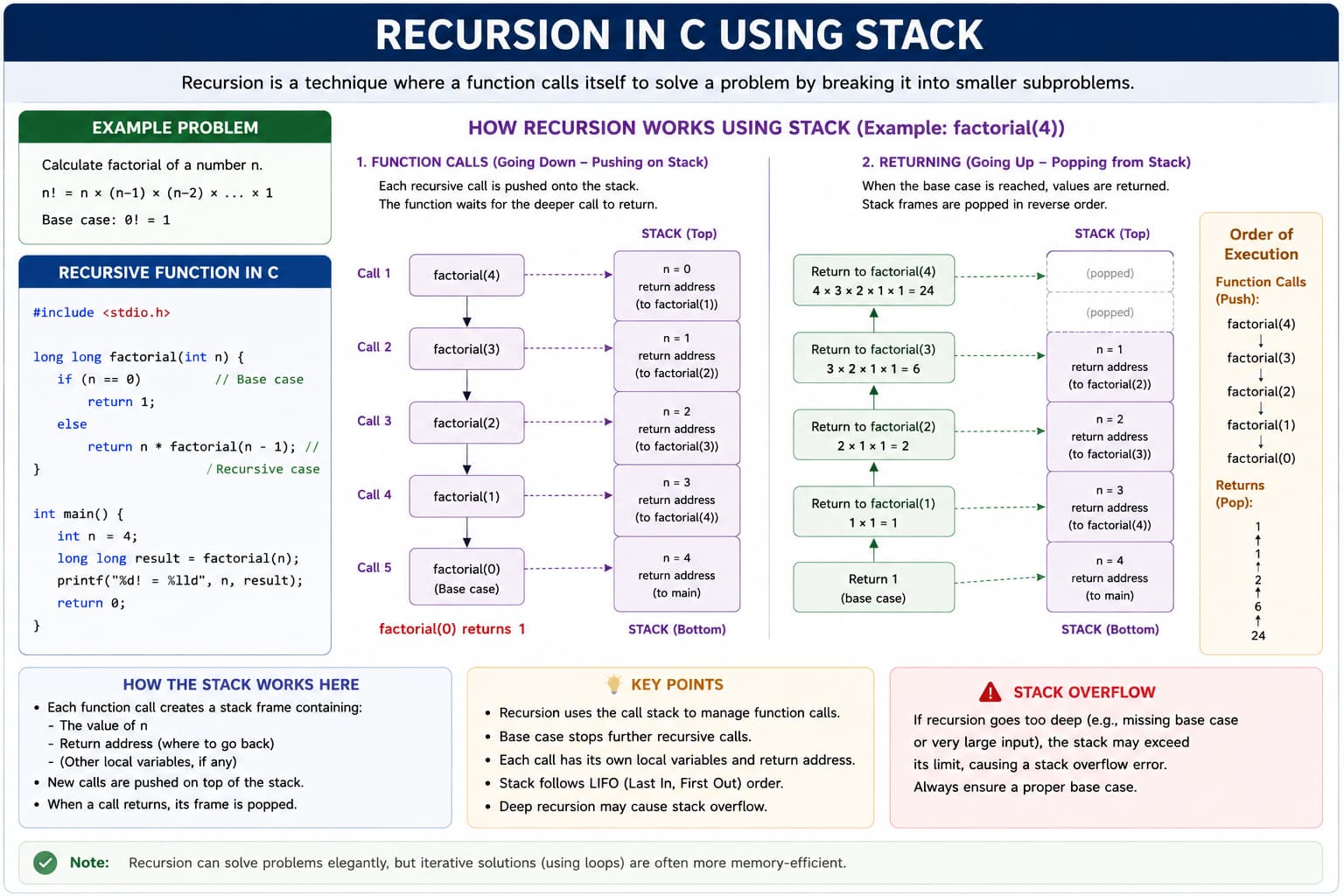
How Factorial Recursion Uses the Stack
When you call factorial(4), the CPU does not finish the whole calculation in one step. Each time factorial calls itself, the runtime pushes a new stack frame onto the call stack — a LIFO (last-in, first-out) area of memory that stores active function calls.
Each stack frame for factorial typically holds:
- Parameter
n— the value passed to that call - Return address — where to resume after the nested call returns
- Pending work — for
return n * factorial(n - 1), the current call must wait until the inner call returns before it can multiply
Step 1: Growing the stack (recursive calls)
Calling factorial(4) expands the stack until the base case n <= 1 is reached:
At the deepest point, four factorial frames sit on the stack (for n = 4, 3, 2, 1), plus main. No frame is removed until factorial(1) hits the base case and returns 1.
Step 2: Unwinding the stack (returns)
After the base case returns, each frame pops off the stack as its multiplication completes:
| Call | Expression after inner return | Result returned | Stack action |
|---|---|---|---|
factorial(1) |
base case | 1 |
Frame popped; stack shrinks |
factorial(2) |
2 * 1 |
2 |
Frame popped |
factorial(3) |
3 * 2 |
6 |
Frame popped |
factorial(4) |
4 * 6 |
24 |
Frame popped; main receives 24 |
This unwind phase is why recursion is often drawn as “going down” into calls and “coming back up” on returns. The final answer 24 is built only as the stack collapses.
Why stack size matters
For factorial(n), recursion depth is O(n) — you need about n stack frames at once. If n is very large (or the base case is missing), the call stack runs out of space and the program crashes with a stack overflow. That is why iterative factorial (a loop) is often preferred for large n: it uses constant stack space.
Memory picture for factorial(4):
main → factorial(4) → factorial(3) → factorial(2) → factorial(1) → return 1 → 2×1 → 3×2 → 4×6 → 24
factorial(n) frame remembers its own n until a smaller factorial returns — then multiplication finishes and that frame is destroyed.
#include <stdio.h>

// Tree recursion - inefficient but demonstrates concept
int fibonacci(int n) {
    if (n <= 0) return 0;
    if (n == 1) return 1;

    return fibonacci(n - 1) + fibonacci(n - 2);
}

// Optimized version with memoization
int fibonacci_memo(int n, int memo[]) {
    if (n <= 0) return 0;
    if (n == 1) return 1;

    // Check if already calculated
    if (memo[n] != -1) {
        return memo[n];
    }

    // Calculate and store
    memo[n] = fibonacci_memo(n - 1, memo) + fibonacci_memo(n - 2, memo);
    return memo[n];
}

int main() {
    int n;

    printf("Enter Fibonacci term number: ");
    scanf("%d", &n);

    if (n < 0) {
        printf("Please enter non-negative number.\n");
        return 1;
    }

    printf("\nFibonacci sequence up to term %d:\n", n);
    for (int i = 0; i <= n; i++) {
        printf("F(%d) = %d\n", i, fibonacci(i));
    }

    // Using memoization
    printf("\nUsing memoization (optimized):\n");
    int memo[n + 1];
    for (int i = 0; i <= n; i++) memo[i] = -1;

    printf("F(%d) = %d\n", n, fibonacci_memo(n, memo));

    return 0;
}
Recursion vs Iteration
| Aspect | Recursion | Iteration |
|---|---|---|
| Definition | Function calls itself | Loops (for, while, do-while) |
| Memory Usage | High (stack frames) | Low (few variables) |
| Speed | Slower (function call overhead) | Faster (no overhead) |
| Code Readability | High for recursive problems | High for simple loops |
| Stack Overflow | Possible if deep recursion | Not applicable |
| Best For | Tree/graph problems, backtracking | Simple loops, linear processing |
#include <stdio.h>

// Recursive version
int factorial_recursive(int n) {
    if (n <= 1) return 1;
    return n * factorial_recursive(n - 1);
}

// Iterative version
int factorial_iterative(int n) {
    int result = 1;
    for (int i = 2; i <= n; i++) {
        result *= i;
    }
    return result;
}

int main() {
    int n;

    printf("Enter a number: ");
    scanf("%d", &n);

    printf("\nComparison:\n");
    printf("Recursive factorial(%d) = %d\n", n, factorial_recursive(n));
    printf("Iterative factorial(%d) = %d\n", n, factorial_iterative(n));

    return 0;
}
Common Pitfalls and Best Practices
Recursion Best Practices:
- Define base case first: Always start with termination condition
- Ensure progress: Each call must move closer to base case
- Use tail recursion when possible: Can be optimized by compiler
- Memoize repeated calculations: Store results to avoid recomputation
- Know recursion depth limits: Typically 1000-10000 calls
- Consider iteration alternative: Often more efficient
- Use recursion for tree-like structures: Natural fit for hierarchical data
- Test with edge cases: Empty, single element, maximum depth
Key Takeaways
- Recursion is a function calling itself to solve smaller subproblems
- Every recursive function needs a base case to stop recursion
- The call stack stores information about active function calls
- Types of recursion: Direct, Indirect, Tail, and Tree recursion
- Tail recursion can be optimized by compilers to use less stack memory
- Recursion is elegant for tree/graph problems but can be inefficient
- Watch for stack overflow with deep recursion (1000+ calls typically)
- Memoization stores results to avoid redundant calculations
- Recursion vs Iteration: Choose based on problem complexity and constraints
- Practice with classical problems: Factorial, Fibonacci, Towers of Hanoi