Java Multithreading - Complete Tutorial
Master Java Multithreading: Learn Thread, Runnable, Executors, ThreadPool, Synchronization, Locks, Concurrent Collections, CompletableFuture, and best practices for high-performance applications.
What is Multithreading?
Multithreading allows concurrent execution of multiple threads within a single program. Threads share the same memory space but execute independently.
Why Use Multithreading?
- Better CPU utilization — Keep CPU busy while one thread waits for I/O
- Improved responsiveness — UI remains responsive during background tasks
- Faster processing — Parallel execution on multi-core processors
- Resource sharing — Threads share memory more efficiently than processes
Thread or Runnable; synchronize shared mutable state.
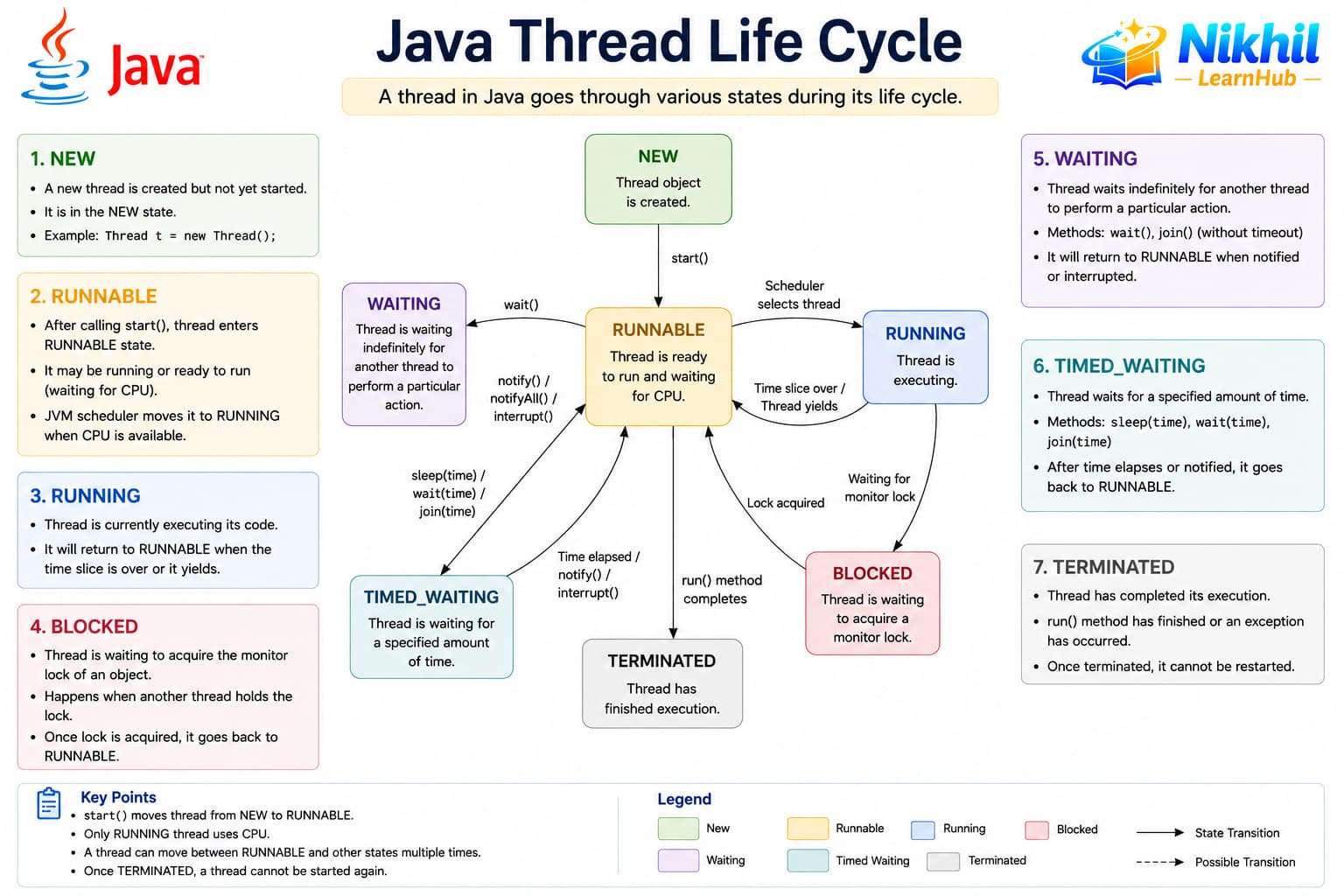
Thread Lifecycle
A thread can be in one of six states during its lifetime:
NEW → RUNNABLE → RUNNING → BLOCKED / WAITING / TIMED_WAITING → TERMINATED
| State | Description |
|---|---|
NEW | Thread created but not started |
RUNNABLE | Ready to run, waiting for CPU |
BLOCKED | Waiting for monitor lock |
WAITING | Waiting indefinitely for another thread |
TIMED_WAITING | Waiting for specified time |
TERMINATED | Thread execution completed |
Creating Threads
Method 1: Extending Thread Class
public class MyThread extends Thread {

    @Override
    public void run() {
        System.out.println("Thread " + Thread.currentThread().getName() + " is running");

        for (int i = 1; i <= 5; i++) {
            System.out.println(Thread.currentThread().getName() + ": Count " + i);
            try {
                Thread.sleep(500); // Pause for 500ms
            } catch (InterruptedException e) {
                System.out.println("Thread interrupted");
            }
        }
    }

    public static void main(String[] args) {
        MyThread t1 = new MyThread();
        MyThread t2 = new MyThread();

        t1.setName("Thread-A");
        t2.setName("Thread-B");

        t1.start(); // Starts thread execution
        t2.start();
    }
}
Method 2: Implementing Runnable Interface (Recommended)
public class MyRunnable implements Runnable {

    @Override
    public void run() {
        System.out.println("Running in " + Thread.currentThread().getName());

        for (int i = 0; i < 5; i++) {
            System.out.println(Thread.currentThread().getName() + " - Iteration " + i);
        }
    }

    public static void main(String[] args) {
        // Create Runnable objects
        MyRunnable task1 = new MyRunnable();
        MyRunnable task2 = new MyRunnable();

        // Create threads with Runnable
        Thread thread1 = new Thread(task1, "Worker-1");
        Thread thread2 = new Thread(task2, "Worker-2");

        thread1.start();
        thread2.start();

        // Using lambda (Java 8+)
        Thread thread3 = new Thread(() -> {
            System.out.println("Lambda thread running");
        }, "Lambda-Thread");
        thread3.start();
    }
}
Method 3: Using Lambda Expressions (Java 8+)
public class LambdaThreadExample {
    public static void main(String[] args) {
        // Simple lambda
        Thread t1 = new Thread(() -> {
            System.out.println("Thread 1 is running");
        });

        // Lambda with parameters
        Thread t2 = new Thread(() -> {
            for (int i = 1; i <= 3; i++) {
                System.out.println("Count: " + i);
                try { Thread.sleep(100); }
                catch (InterruptedException e) {}
            }
        });

        t1.start();
        t2.start();
    }
}
Method 4: Using Callable and Future (Return values)
import java.util.concurrent.*;

public class CallableExample {
    public static void main(String[] args) throws Exception {
        // Create Callable that returns a result
        Callable<Integer> task = () -> {
            int sum = 0;
            for (int i = 1; i <= 10; i++) {
                sum += i;
                Thread.sleep(100);
            }
            return sum;
        };

        // Execute Callable
        ExecutorService executor = Executors.newSingleThreadExecutor();
        Future<Integer> future = executor.submit(task);

        // Do other work while task runs
        System.out.println("Waiting for result...");

        // Get result (blocks until available)
        Integer result = future.get();
        System.out.println("Sum from 1 to 10 = " + result);

        executor.shutdown();
    }
}
Thread Methods and Control
Essential Thread Methods
public class ThreadMethodsDemo {
    public static void main(String[] args) throws InterruptedException {

        Thread worker = new Thread(() -> {
            for (int i = 1; i <= 5; i++) {
                System.out.println("Working: " + i);
                try {
                    Thread.sleep(500);
                } catch (InterruptedException e) {
                    System.out.println("Thread was interrupted!");
                    return;
                }
            }
        });

        // Set thread properties
        worker.setName("WorkerThread");
        worker.setPriority(Thread.MAX_PRIORITY); // 1-10, default 5
        worker.setDaemon(true); // Daemon thread exits when main thread ends

        System.out.println("Thread state before start: " + worker.getState());

        worker.start();

        System.out.println("Thread state after start: " + worker.getState());

        // Main thread sleeps
        Thread.sleep(1200);

        // Interrupt the thread
        worker.interrupt();

        // Wait for thread to finish
        worker.join(); // Main waits for worker to die

        System.out.println("Thread state after completion: " + worker.getState());
        System.out.println("Is alive? " + worker.isAlive());
    }
}
Thread Priority Example
public class PriorityExample {
    public static void main(String[] args) {
        Thread low = new Thread(() -> {
            for (int i = 0; i < 5; i++) {
                System.out.println("Low priority: " + i);
            }
        });

        Thread high = new Thread(() -> {
            for (int i = 0; i < 5; i++) {
                System.out.println("HIGH priority: " + i);
            }
        });

        low.setPriority(Thread.MIN_PRIORITY);  // 1
        high.setPriority(Thread.MAX_PRIORITY); // 10

        low.start();
        high.start();

        // Note: Priority is a hint, not guaranteed
    }
}
Synchronization and Thread Safety
When multiple threads access shared resources, synchronization prevents data corruption.
Problem: Race Condition
class Counter {
    private int count = 0;

    public void increment() {
        count++; // Not atomic! Three operations: read, increment, write
    }

    public int getCount() {
        return count;
    }
}

public class RaceConditionDemo {
    public static void main(String[] args) throws InterruptedException {
        Counter counter = new Counter();

        Thread t1 = new Thread(() -> {
            for (int i = 0; i < 1000; i++) counter.increment();
        });

        Thread t2 = new Thread(() -> {
            for (int i = 0; i < 1000; i++) counter.increment();
        });

        t1.start();
        t2.start();

        t1.join();
        t2.join();

        System.out.println("Expected: 2000, Actual: " + counter.getCount());
        // Output might be less than 2000 due to race condition!
    }
}
Solution 1: Synchronized Method
class SynchronizedCounter {
    private int count = 0;

    public synchronized void increment() {
        count++; // Only one thread can execute this at a time
    }

    public synchronized int getCount() {
        return count;
    }
}

// Now the result will always be 2000
Solution 2: Synchronized Block
class SynchronizedBlockCounter {
    private int count = 0;
    private final Object lock = new Object(); // Lock object

    public void increment() {
        synchronized(lock) {
            count++;
        }
    }

    public int getCount() {
        synchronized(lock) {
            return count;
        }
    }
}
Solution 3: Volatile Keyword
class VolatileExample {
    private volatile boolean running = true; // Changes visible to all threads

    public void run() {
        while (running) {
            // Do work
        }
    }

    public void stop() {
        running = false; // Immediately visible to other threads
    }
}
Practical Example: Bank Account
class BankAccount {
    private double balance;
    private final Object lock = new Object();

    public BankAccount(double initialBalance) {
        this.balance = initialBalance;
    }

    public void deposit(double amount) {
        synchronized(lock) {
            balance += amount;
            System.out.println(Thread.currentThread().getName() +
                " deposited " + amount +
                ", balance: " + balance);
        }
    }

    public boolean withdraw(double amount) {
        synchronized(lock) {
            if (balance >= amount) {
                balance -= amount;
                System.out.println(Thread.currentThread().getName() +
                    " withdrew " + amount +
                    ", balance: " + balance);
                return true;
            }
            System.out.println(Thread.currentThread().getName() +
                " insufficient funds!");
            return false;
        }
    }

    public double getBalance() {
        synchronized(lock) {
            return balance;
        }
    }
}

public class BankDemo {
    public static void main(String[] args) throws InterruptedException {
        BankAccount account = new BankAccount(1000);

        // Multiple threads accessing same account
        Thread user1 = new Thread(() -> {
            for (int i = 0; i < 5; i++) {
                account.deposit(100);
                try { Thread.sleep(50); } catch (InterruptedException e) {}
            }
        }, "User-1");

        Thread user2 = new Thread(() -> {
            for (int i = 0; i < 5; i++) {
                account.withdraw(150);
                try { Thread.sleep(50); } catch (InterruptedException e) {}
            }
        }, "User-2");

        user1.start();
        user2.start();

        user1.join();
        user2.join();

        System.out.println("Final balance: " + account.getBalance());
    }
}
Inter-thread Communication
wait(), notify(), and notifyAll() coordinate producer-consumer style communication between threads.
class MessageQueue {
    private String message;
    private boolean hasMessage = false;

    public synchronized void put(String message) {
        while (hasMessage) {
            try {
                wait(); // Wait for consumer to consume
            } catch (InterruptedException e) {}
        }

        this.message = message;
        hasMessage = true;
        System.out.println("Produced: " + message);
        notify(); // Notify waiting consumer
    }

    public synchronized String take() {
        while (!hasMessage) {
            try {
                wait(); // Wait for producer to produce
            } catch (InterruptedException e) {}
        }

        hasMessage = false;
        System.out.println("Consumed: " + message);
        notify(); // Notify waiting producer
        return message;
    }
}

public class ProducerConsumerDemo {
    public static void main(String[] args) {
        MessageQueue queue = new MessageQueue();

        // Producer thread
        Thread producer = new Thread(() -> {
            String[] messages = {"Hello", "World", "Java", "Multithreading", "Done"};
            for (String msg : messages) {
                queue.put(msg);
                try { Thread.sleep(500); } catch (InterruptedException e) {}
            }
        });

        // Consumer thread
        Thread consumer = new Thread(() -> {
            for (int i = 0; i < 5; i++) {
                String msg = queue.take();
                try { Thread.sleep(1000); } catch (InterruptedException e) {}
            }
        });

        producer.start();
        consumer.start();
    }
}
Thread Pools (Executor Framework)
Managing threads manually is inefficient. Use ExecutorService for thread pooling.
Fixed Thread Pool
import java.util.concurrent.*;

public class ThreadPoolExample {
    public static void main(String[] args) {
        // Create a pool of 3 threads
        ExecutorService executor = Executors.newFixedThreadPool(3);

        // Submit tasks
        for (int i = 1; i <= 10; i++) {
            final int taskId = i;
            executor.submit(() -> {
                System.out.println("Task " + taskId + " executed by " +
                    Thread.currentThread().getName());
                try {
                    Thread.sleep(1000);
                } catch (InterruptedException e) {}
            });
        }

        // Shutdown executor
        executor.shutdown();

        // Wait for all tasks to complete
        try {
            executor.awaitTermination(1, TimeUnit.MINUTES);
        } catch (InterruptedException e) {}

        System.out.println("All tasks completed");
    }
}
Different Executor Types
import java.util.concurrent.*;

public class ExecutorTypesDemo {
    public static void main(String[] args) {
        // 1. Fixed thread pool - Reuses fixed number of threads
        ExecutorService fixedPool = Executors.newFixedThreadPool(5);

        // 2. Cached thread pool - Creates threads as needed, reuses idle ones
        ExecutorService cachedPool = Executors.newCachedThreadPool();

        // 3. Single thread executor - One thread, tasks execute sequentially
        ExecutorService singlePool = Executors.newSingleThreadExecutor();

        // 4. Scheduled thread pool - For delayed/recurring tasks
        ScheduledExecutorService scheduledPool = Executors.newScheduledThreadPool(2);

        // Schedule task with delay
        scheduledPool.schedule(() -> {
            System.out.println("Delayed task executed");
        }, 3, TimeUnit.SECONDS);

        // Schedule recurring task
        scheduledPool.scheduleAtFixedRate(() -> {
            System.out.println("Recurring task");
        }, 1, 2, TimeUnit.SECONDS);

        // Shutdown after some time
        try {
            Thread.sleep(10000);
        } catch (InterruptedException e) {}

        fixedPool.shutdown();
        cachedPool.shutdown();
        singlePool.shutdown();
        scheduledPool.shutdown();
    }
}
Concurrency Utilities
CountDownLatch
import java.util.concurrent.CountDownLatch;

public class CountDownLatchExample {
    public static void main(String[] args) throws InterruptedException {
        CountDownLatch latch = new CountDownLatch(3); // Wait for 3 tasks

        // Create worker threads
        for (int i = 1; i <= 3; i++) {
            final int workerId = i;
            new Thread(() -> {
                System.out.println("Worker " + workerId + " is working");
                try {
                    Thread.sleep(2000);
                } catch (InterruptedException e) {}
                System.out.println("Worker " + workerId + " finished");
                latch.countDown(); // Decrement counter
            }).start();
        }

        System.out.println("Main thread waiting for workers...");
        latch.await(); // Wait until count reaches 0
        System.out.println("All workers completed! Main thread proceeds.");
    }
}
CyclicBarrier
import java.util.concurrent.BrokenBarrierException;
import java.util.concurrent.CyclicBarrier;

public class CyclicBarrierExample {
    public static void main(String[] args) {
        CyclicBarrier barrier = new CyclicBarrier(3, () -> {
            System.out.println("All threads reached barrier! Let's proceed.");
        });

        for (int i = 1; i <= 3; i++) {
            final int threadId = i;
            new Thread(() -> {
                System.out.println("Thread " + threadId + " is working...");
                try {
                    Thread.sleep(threadId * 1000);
                    System.out.println("Thread " + threadId + " reached barrier");
                    barrier.await(); // Wait for others
                    System.out.println("Thread " + threadId + " passed barrier");
                } catch (InterruptedException | BrokenBarrierException e) {}
            }).start();
        }
    }
}
Semaphore
import java.util.concurrent.Semaphore;

public class SemaphoreExample {
    public static void main(String[] args) {
        Semaphore semaphore = new Semaphore(2); // Allow 2 concurrent accesses

        for (int i = 1; i <= 5; i++) {
            final int threadId = i;
            new Thread(() -> {
                try {
                    System.out.println("Thread " + threadId + " waiting for permit");
                    semaphore.acquire(); // Acquire permit
                    System.out.println("Thread " + threadId + " acquired permit");

                    // Critical section
                    Thread.sleep(2000);

                    semaphore.release(); // Release permit
                    System.out.println("Thread " + threadId + " released permit");
                } catch (InterruptedException e) {}
            }).start();
        }
    }
}
CompletableFuture (Java 8+)
import java.util.concurrent.CompletableFuture;

public class CompletableFutureExample {
    public static void main(String[] args) throws Exception {
        // Async computation
        CompletableFuture<String> future = CompletableFuture.supplyAsync(() -> {
            System.out.println("Computing in " + Thread.currentThread().getName());
            return "Hello";
        }).thenApply(result -> {
            return result + " World";
        }).thenApply(String::toUpperCase);

        // Chain multiple operations
        CompletableFuture<Integer> future2 = CompletableFuture.supplyAsync(() -> 10)
            .thenApply(num -> num * 2)
            .thenApply(num -> num + 5);

        // Combine two futures
        CompletableFuture<String> combined = future.thenCombine(future2,
            (str, num) -> str + " - " + num);

        System.out.println(combined.get()); // HELLO WORLD - 25

        // Handle exceptions
        CompletableFuture<Integer> errorFuture = CompletableFuture.supplyAsync(() -> {
            if (true) throw new RuntimeException("Error occurred");
            return 42;
        }).exceptionally(ex -> {
            System.out.println("Error: " + ex.getMessage());
            return 0;
        });

        System.out.println(errorFuture.get()); // 0
    }
}
Atomic Variables and Locks
Atomic Variables (java.util.concurrent.atomic)
import java.util.concurrent.atomic.*;

public class AtomicExample {
    public static void main(String[] args) throws InterruptedException {
        // AtomicInteger - Thread-safe integer operations
        AtomicInteger counter = new AtomicInteger(0);

        Thread t1 = new Thread(() -> {
            for (int i = 0; i < 1000; i++) {
                counter.incrementAndGet(); // Atomic increment
            }
        });

        Thread t2 = new Thread(() -> {
            for (int i = 0; i < 1000; i++) {
                counter.incrementAndGet();
            }
        });

        t1.start();
        t2.start();
        t1.join();
        t2.join();

        System.out.println("Atomic counter: " + counter.get()); // Always 2000

        // Other atomic types
        AtomicBoolean flag = new AtomicBoolean(false);
        AtomicLong longValue = new AtomicLong(100L);
        AtomicReference<String> reference = new AtomicReference<>("Hello");

        // Compare and set
        reference.compareAndSet("Hello", "World");
        System.out.println(reference.get()); // World

        // Atomic operations
        int oldValue = counter.getAndSet(500);
        int updated = counter.addAndGet(100);
        System.out.println("Old: " + oldValue + ", Updated: " + updated);
    }
}
ReentrantLock
import java.util.concurrent.locks.*;

class LockedCounter {
    private int count = 0;
    private final ReentrantLock lock = new ReentrantLock();
    private final Condition condition = lock.newCondition();

    public void increment() {
        lock.lock();
        try {
            count++;
            condition.signalAll(); // Notify waiting threads
        } finally {
            lock.unlock(); // Always unlock in finally block
        }
    }

    public void waitForValue(int target) throws InterruptedException {
        lock.lock();
        try {
            while (count < target) {
                condition.await(); // Wait for condition
            }
            System.out.println("Target " + target + " reached!");
        } finally {
            lock.unlock();
        }
    }

    public int getCount() {
        lock.lock();
        try {
            return count;
        } finally {
            lock.unlock();
        }
    }
}

public class ReentrantLockDemo {
    public static void main(String[] args) {
        LockedCounter counter = new LockedCounter();

        // Thread waiting for counter to reach 5
        Thread waiter = new Thread(() -> {
            try {
                counter.waitForValue(5);
            } catch (InterruptedException e) {}
        });

        // Thread incrementing counter
        Thread incrementer = new Thread(() -> {
            for (int i = 0; i < 10; i++) {
                counter.increment();
                System.out.println("Count: " + counter.getCount());
                try { Thread.sleep(500); } catch (InterruptedException e) {}
            }
        });

        waiter.start();
        incrementer.start();
    }
}
Deadlock and Prevention
What is Deadlock?
class DeadlockExample {
    private static final Object LOCK1 = new Object();
    private static final Object LOCK2 = new Object();

    public static void main(String[] args) {
        Thread t1 = new Thread(() -> {
            synchronized(LOCK1) {
                System.out.println("Thread 1: Holding LOCK1");
                try { Thread.sleep(100); } catch (InterruptedException e) {}

                System.out.println("Thread 1: Waiting for LOCK2");
                synchronized(LOCK2) {
                    System.out.println("Thread 1: Acquired LOCK2");
                }
            }
        });

        Thread t2 = new Thread(() -> {
            synchronized(LOCK2) {
                System.out.println("Thread 2: Holding LOCK2");
                try { Thread.sleep(100); } catch (InterruptedException e) {}

                System.out.println("Thread 2: Waiting for LOCK1");
                synchronized(LOCK1) {
                    System.out.println("Thread 2: Acquired LOCK1");
                }
            }
        });

        t1.start();
        t2.start();
        // DEADLOCK! Both threads waiting for each other's locks
    }
}
Preventing Deadlock
import java.util.concurrent.TimeUnit;
import java.util.concurrent.locks.ReentrantLock;

class DeadlockPrevention {
    private static final Object LOCK1 = new Object();
    private static final Object LOCK2 = new Object();

    // Solution 1: Always acquire locks in same order
    static class Solution1 {
        public void method1() {
            synchronized(LOCK1) {
                synchronized(LOCK2) {
                    // Safe - same order as method2
                }
            }
        }

        public void method2() {
            synchronized(LOCK1) {
                synchronized(LOCK2) {
                    // Safe - same order
                }
            }
        }
    }

    // Solution 2: Use tryLock() with timeout
    static class Solution2 {
        private final ReentrantLock lock1 = new ReentrantLock();
        private final ReentrantLock lock2 = new ReentrantLock();

        public void safeMethod() {
            boolean locked1 = false;
            boolean locked2 = false;

            try {
                locked1 = lock1.tryLock(1, TimeUnit.SECONDS);
                locked2 = lock2.tryLock(1, TimeUnit.SECONDS);

                if (locked1 && locked2) {
                    // Perform operations
                }
            } catch (InterruptedException e) {
                System.out.println("Could not acquire locks");
            } finally {
                if (locked1) lock1.unlock();
                if (locked2) lock2.unlock();
            }
        }
    }
}
Command Line Arguments in Multithreading
Pass command-line arguments to configure multithreaded applications:
import java.util.concurrent.*;

public class ThreadConfigFromArgs {

    static class Config {
        int numThreads;
        int taskCount;
        int delayMs;

        Config(String[] args) {
            // Parse command line arguments
            this.numThreads = args.length > 0 ? Integer.parseInt(args[0]) : 4;
            this.taskCount = args.length > 1 ? Integer.parseInt(args[1]) : 20;
            this.delayMs = args.length > 2 ? Integer.parseInt(args[2]) : 100;
        }
    }

    public static void main(String[] args) {
        Config config = new Config(args);

        System.out.println("Configuration:");
        System.out.println("Threads: " + config.numThreads);
        System.out.println("Tasks: " + config.taskCount);
        System.out.println("Delay: " + config.delayMs + "ms");

        // Create thread pool based on config
        ExecutorService executor = Executors.newFixedThreadPool(config.numThreads);

        // Submit tasks
        for (int i = 0; i < config.taskCount; i++) {
            final int taskId = i;
            executor.submit(() -> {
                try {
                    System.out.println("Task " + taskId + " started by " +
                        Thread.currentThread().getName());
                    Thread.sleep(config.delayMs);
                    System.out.println("Task " + taskId + " completed");
                } catch (InterruptedException e) {
                    Thread.currentThread().interrupt();
                }
            });
        }

        executor.shutdown();
        try {
            executor.awaitTermination(1, TimeUnit.MINUTES);
        } catch (InterruptedException e) {
            e.printStackTrace();
        }

        System.out.println("All tasks completed");
    }
}
Running with arguments:
java ThreadConfigFromArgs 8 100 50
# 8 threads, 100 tasks, 50ms delay per task
Real-World Examples
This tutorial includes several patterns you will see in production code:
| Example | Use Case | Section |
|---|---|---|
BankDemo |
Thread-safe shared resource (bank account deposits and withdrawals) | Synchronization |
ProducerConsumerDemo |
Producer-consumer coordination with wait() / notify() |
Inter-thread Communication |
ThreadConfigFromArgs |
Configurable thread pool driven by command-line arguments | Command Line Arguments |
Together, these examples show how to protect shared state, coordinate work between threads, and scale concurrency settings without changing source code.
Best Practices and Common Pitfalls
DO's
import java.util.concurrent.*;
import java.util.concurrent.locks.*;
import java.util.*;

// 1. Always use thread-safe collections
Map<String, String> map = new ConcurrentHashMap<>();
List<String> list = new CopyOnWriteArrayList<>();
Queue<String> queue = new ConcurrentLinkedQueue<>();

// 2. Use ExecutorService instead of raw threads
ExecutorService executor = Executors.newFixedThreadPool(10);

// 3. Always release locks in finally block
Lock lock = new ReentrantLock();
lock.lock();
try {
    // critical section
} finally {
    lock.unlock();
}

// 4. Use volatile for flags
private volatile boolean running = true;

// 5. Prefer higher-level concurrency utilities
CountDownLatch latch = new CountDownLatch(3);
DON'Ts
// 1. Don't use Thread.stop() (deprecated and unsafe)
// Thread.stop(); // DON'T DO THIS

// 2. Don't ignore InterruptedException
try {
    Thread.sleep(1000);
} catch (InterruptedException e) {
    // DON'T just print - restore interrupted status
    Thread.currentThread().interrupt();
}

// 3. Don't synchronize on non-final objects
String s = "hello";
synchronized(s) { // BAD - s might change
    // ...
}

// 4. Don't call Thread.sleep() in synchronized blocks
synchronized(lock) {
    Thread.sleep(1000); // BAD - holding lock while sleeping
}

// 5. Don't use Vector or Hashtable (use concurrent collections instead)
// Vector<String> v = new Vector<>(); // Consider ArrayList with synchronization
Summary Table
| Concept | When to Use | Example |
|---|---|---|
Thread | Simple background tasks | new Thread(() -> {}).start() |
Runnable | Task that doesn't return result | executor.submit(() -> {}) |
Callable | Task that returns result | Future<T> result = executor.submit(callable) |
synchronized | Simple mutual exclusion | synchronized(this) { } |
ReentrantLock | Advanced locking (tryLock, conditions) | lock.lock(); try {} finally { lock.unlock(); } |
ExecutorService | Managing thread pools | Executors.newFixedThreadPool(10) |
BlockingQueue | Producer-consumer patterns | new ArrayBlockingQueue<>(5) |
CountDownLatch | Waiting for multiple threads | latch.await(); latch.countDown() |
AtomicInteger | Simple counters | counter.incrementAndGet() |
CompletableFuture | Asynchronous pipelines | future.thenApply().thenAccept() |