Java Recursion - Complete Tutorial
Master Java Recursion: Learn recursive functions, base cases, recursion vs iteration comparison, factorial, Fibonacci, Tower of Hanoi, recursion tree visualization, and best practices.
1. Introduction to Recursion
Recursion solves problems by breaking them into smaller instances of the same problem. Every recursive algorithm needs a base case and a recursive case.
- Function calls itself
- Base case stops recursion
- Recursive case moves toward base
- Uses call stack for state
public class RecursionIntro {
    static void countdown(int n) {
        if (n == 0) return;
        System.out.println(n);
        countdown(n - 1);
    }
    public static void main(String[] args) {
        countdown(3);
    }
}
2. Why Is Recursion Required?
Not every problem needs recursion, but some problems are naturally defined in terms of smaller versions of themselves. Recursion is required (or strongly preferred) when:
- The problem definition itself is recursive (factorial, Fibonacci, tree height)
- Data is recursive in shape (trees, linked lists, file folders)
- Divide-and-conquer is the clearest solution (merge sort, quick sort, binary search)
- Backtracking needs to explore choices and undo them (maze, N-Queens, permutations)
- The iterative version would need an explicit stack you manage by hand — recursion uses the JVM call stack for you
Key idea
Use recursion when the structure of the problem matches the structure of the solution. If a simple loop is clearer and fast enough, prefer iteration.
3. Applications of Recursion
| Area | Example | Why recursion fits |
|---|---|---|
| Mathematics | Factorial, GCD, power xn | Formula refers to smaller n |
| Number series | Fibonacci | F(n) = F(n-1) + F(n-2) |
| Searching | Binary search on sorted array | Search left or right half |
| Sorting | Merge sort, quick sort | Sort halves, then combine |
| Trees | Traversal (in/pre/post order) | Visit node + recurse on children |
| Graphs | DFS path finding | Explore neighbor, backtrack |
| Puzzles | Tower of Hanoi | Move n-1 disks, then largest disk |
| Strings | Palindrome check | Compare ends, recurse on middle |
| Combinatorics | Permutations, subsets | Choose / skip each element |
4. Iterative vs Recursion
| Aspect | Iteration (loop) | Recursion |
|---|---|---|
| Control flow | for, while, do-while | Method calls itself |
| Memory | Usually O(1) extra space | O(depth) call stack frames |
| Speed | Faster (no call overhead) | Slower due to repeated calls |
| Readability | Better for simple counting/repeat tasks | Better for trees, divide-and-conquer |
| Debugging | Easier to trace in small loops | Harder — deep call stacks |
| Risk | Infinite loop if condition wrong | StackOverflowError if no base case |
| Java note | Preferred for large n (e.g. factorial of 10,000) | Tail-call optimization not guaranteed in JVM |
public class FactCompare {
    static int factorialIterative(int n) {
        int result = 1;
        for (int i = 2; i <= n; i++) {
            result *= i;
        }
        return result;
    }

    static int factorialRecursive(int n) {
        if (n <= 1) return 1;
        return n * factorialRecursive(n - 1);
    }

    public static void main(String[] args) {
        int n = 5;
        System.out.println("Iterative: " + factorialIterative(n));
        System.out.println("Recursive: " + factorialRecursive(n));
    }
}
5. Classic Recursive Algorithms
Factorial, Fibonacci, and binary search are textbook recursive examples. Understanding them builds intuition for tree and graph recursion.
- Factorial: n! = n * (n-1)!
- Fibonacci: F(n) = F(n-1) + F(n-2)
- Binary search halves search space
- Tower of Hanoi moves disks recursively
public class Fibonacci {
    static int fib(int n) {
        if (n <= 1) return n;
        return fib(n - 1) + fib(n - 2);
    }
    public static void main(String[] args) {
        System.out.println(fib(6));
    }
}
6. How Recursion Uses the Stack
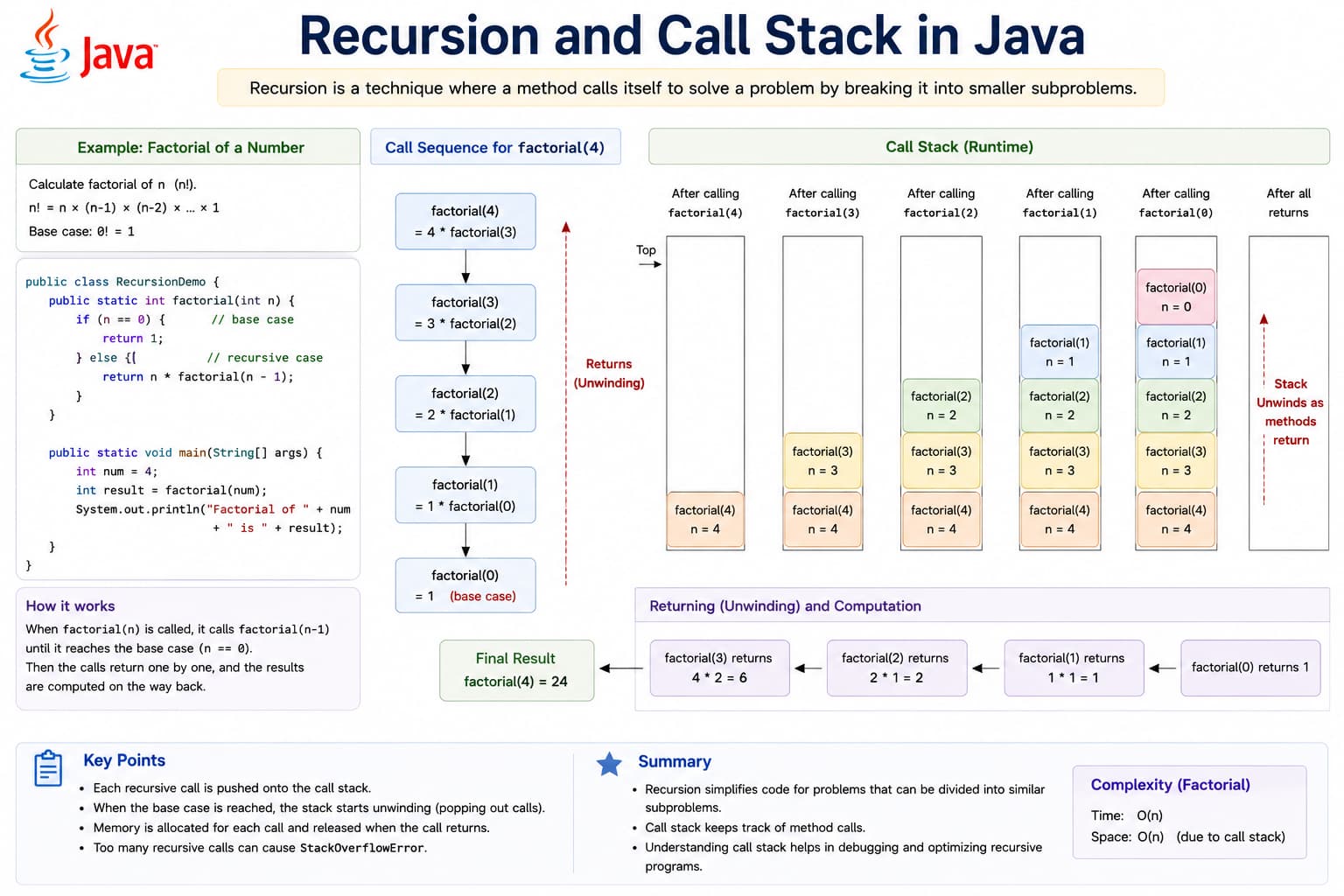
Each recursive call pushes a new stack frame onto the JVM call stack. The frame stores local variables (e.g. n), return address, and pending work until the inner call returns.
Example: factorial(4)
Growing phase — calls stack up until base case:
main→factorial(4)→factorial(3)→factorial(2)→factorial(1)
Unwinding phase — returns multiply backward:
| Call | Returns | Stack |
|---|---|---|
factorial(1) | 1 | Frame popped |
factorial(2) | 2 × 1 = 2 | Frame popped |
factorial(3) | 3 × 2 = 6 | Frame popped |
factorial(4) | 4 × 6 = 24 | Frame popped; main gets 24 |
public class FactorialStack {
    static int factorial(int n) {
        System.out.println("  Enter factorial(" + n + ")");
        if (n <= 1) {
            System.out.println("  Base case, return 1");
            return 1;
        }
        int result = n * factorial(n - 1);
        System.out.println("  Leave factorial(" + n + "), return " + result);
        return result;
    }

    public static void main(String[] args) {
        System.out.println("Result: " + factorial(4));
    }
}
Depth for factorial(n) is O(n) frames at once — why very large n can cause StackOverflowError.
7. Disadvantages of Recursion
| Disadvantage | Explanation |
|---|---|
| Stack overflow | Too many nested calls exhaust call stack memory (StackOverflowError) |
| Extra memory | Each call uses a stack frame — O(depth) vs O(1) for a loop |
| Slower execution | Method call overhead on every step |
| Repeated work | Naive Fibonacci recalculates same values (fix with memoization) |
| Harder debugging | Deep stacks are difficult to read in logs and debuggers |
| No guaranteed tail optimization in Java | Even tail-recursive code may still use stack depth |
8. Recursion Tree Visualization
Drawing the call tree shows how recursive calls branch and reunite. Each node is a call; edges show the next smaller subproblem.
- Root is initial call
- Leaves are base cases
- Depth equals maximum stack depth
- Overlapping subproblems suggest memoization
public class Trace {
    static int sum(int n) {
        System.out.println("sum(" + n + ")");
        if (n == 0) return 0;
        return n + sum(n - 1);
    }
    public static void main(String[] args) {
        System.out.println("Result: " + sum(3));
    }
}
9. Tail Recursion
Tail recursion occurs when the recursive call is the last operation. Some languages optimize it to iteration; Java does not guarantee tail-call optimization.
- Last action is recursive call
- Can carry result in accumulator parameter
- Rewrite as loop for efficiency in Java
- Still useful for expressing logic clearly
public class TailSum {
    static int sum(int n, int acc) {
        if (n == 0) return acc;
        return sum(n - 1, acc + n);
    }
    public static void main(String[] args) {
        System.out.println(sum(5, 0));
    }
}
10. Recursion Best Practices
Use recursion when it simplifies the solution, but watch stack overflow and redundant work.
- Always define a reachable base case
- Ensure each recursive step moves toward the base case
- Use memoization for overlapping subproblems
- Prefer iteration when performance or depth is critical
- Test with small inputs first
11. Tricky Points
Common recursion mistakes in Java exams and coding practice.
void bad(int n) { bad(n - 1); } never stops → StackOverflowError, not an infinite loop in the usual sense.
if (n == 0) but you call fact(n - 2) from odd n — recursion never hits zero.
fib(n-1) + fib(n-2), not fib(n-1) alone. For factorial, n * fact(n-1), not fact(n-1) only.
fib(40) takes billions of calls — use memoization or iteration for large n.
factorial(20) fits in int; factorial(13) already overflows if you are not careful with types — use long or BigInteger.
Checklist before submitting recursive code
Base case defined? Progress toward base? Correct return expression? Stack depth acceptable? Can iteration do it simpler? If yes to the last two concerns, consider a loop.