Python Operators Complete Guide
Learn all Python operators - arithmetic, comparison, logical, assignment, bitwise, membership, and identity operators with practical examples and operator precedence rules.
Arithmetic
Math operations
Comparison
Relational operators
Logical
AND, OR, NOT
Bitwise
Binary operations
What are Python Operators?
Operators are special symbols in Python that perform operations on variables and values. Python provides various types of operators to perform different tasks.
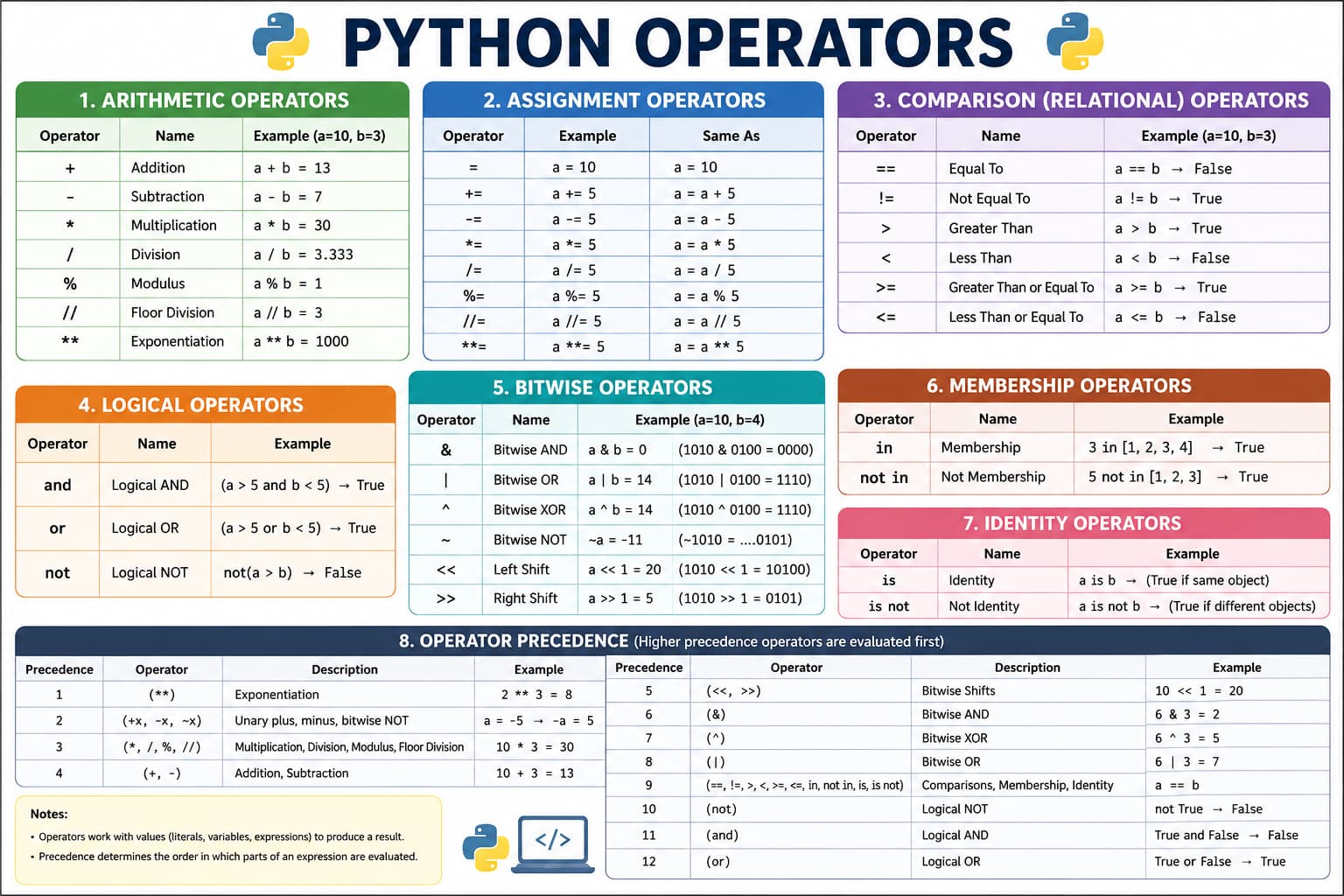
Key Concept
Operators work on operands. For example, in 5 + 3, + is the operator, and 5 and 3 are operands.
# Arithmetic operators
result = 10 + 5    # Addition
result = 10 - 5    # Subtraction
result = 10 * 5    # Multiplication
result = 10 / 3    # Division (returns float)

# Comparison operators
is_equal = (10 == 5)      # Equal to
is_greater = (10 > 5)     # Greater than
is_less = (10 < 5)        # Less than

# Logical operators
result = (10 > 5) and (3 < 7)  # AND operator
result = (10 > 5) or (3 > 7)   # OR operator
result = not (10 > 5)          # NOT operator
Python Operators Classification
Python operators are classified into 7 main categories. Each type serves a specific purpose in programming.
Complete Operators Reference Table
| Operator Type | Symbol/Name | Description | Example | Result |
|---|---|---|---|---|
| Arithmetic | + | Addition - Adds two operands | 5 + 3 |
8 |
| Arithmetic | - | Subtraction - Subtracts right operand from left | 10 - 4 |
6 |
| Arithmetic | * | Multiplication - Multiplies two operands | 7 * 3 |
21 |
| Arithmetic | / | Division - Divides left operand by right (float result) | 10 / 3 |
3.333... |
| Arithmetic | // | Floor Division - Divides and rounds down to nearest integer | 10 // 3 |
3 |
| Arithmetic | % | Modulus - Returns remainder of division | 10 % 3 |
1 |
| Arithmetic | ** | Exponentiation - Raises left operand to power of right | 2 ** 3 |
8 |
| Comparison | == | Equal to - Returns True if operands are equal | 5 == 5 |
True |
| Comparison | != | Not equal to - Returns True if operands are not equal | 5 != 3 |
True |
| Comparison | > | Greater than - Returns True if left is greater than right | 10 > 5 |
True |
| Comparison | < | Less than - Returns True if left is less than right | 3 < 7 |
True |
| Comparison | >= | Greater than or equal to | 10 >= 10 |
True |
| Comparison | <= | Less than or equal to | 5 <= 10 |
True |
| Logical | and | Logical AND - True if both operands are True | True and False |
False |
| Logical | or | Logical OR - True if at least one operand is True | True or False |
True |
| Logical | not | Logical NOT - Reverses the logical state | not True |
False |
| Assignment | = | Assignment - Assigns right value to left variable | x = 5 |
x becomes 5 |
| Assignment | += | Add AND - Adds right to left and assigns to left | x += 3 (same as x = x + 3) |
x increases by 3 |
| Assignment | -= | Subtract AND | x -= 2 |
x decreases by 2 |
| Assignment | *= | Multiply AND | x *= 4 |
x multiplied by 4 |
| Assignment | /= | Divide AND (float division) | x /= 2 |
x divided by 2 |
| Assignment | //= | Floor Divide AND | x //= 2 |
x floor divided by 2 |
| Assignment | %= | Modulus AND | x %= 3 |
x = x % 3 |
| Bitwise | & | Bitwise AND - Sets each bit to 1 if both bits are 1 | 5 & 3 (101 & 011) |
1 (001) |
| Bitwise | | | Bitwise OR - Sets each bit to 1 if one of bits is 1 | 5 | 3 (101 | 011) |
7 (111) |
| Bitwise | ^ | Bitwise XOR - Sets each bit to 1 if only one bit is 1 | 5 ^ 3 (101 ^ 011) |
6 (110) |
| Bitwise | ~ | Bitwise NOT - Inverts all bits | ~5 |
-6 |
| Bitwise | << | Left shift - Shifts bits left, fills with 0 | 5 << 1 (101 becomes 1010) |
10 |
| Bitwise | >> | Right shift - Shifts bits right | 5 >> 1 (101 becomes 10) |
2 |
| Membership | in | Returns True if value exists in sequence | 'a' in "apple" |
True |
| Membership | not in | Returns True if value doesn't exist in sequence | 'z' not in "apple" |
True |
| Identity | is | Returns True if both variables point to same object | x is y |
True/False |
| Identity | is not | Returns True if variables point to different objects | x is not y |
True/False |
==compares values,iscompares object identityandandorare logical operators,&and|are bitwise operators- Assignment operators (
+=,-=) modify variables in place
Python Operators: Complete Theory & Tricky Examples
This section gives short examples, practical use, and tricky interview-level points for each operator category.
1) Arithmetic Operators
Arithmetic operators are used for mathematical calculations. Python follows standard precedence rules.
a = 15
b = 4

print(a + b)          # 19
print(a - b)          # 11
print(a * b)          # 60
print(a / b)          # 3.75 (always float)
print(a // b)         # 3
print(-15 // 4)       # -4 (rounds down)
print(a % b)          # 3
print(a ** b)         # 50625
print(2 ** 10)        # 1024
print(9 ** 0.5)       # 3.0

# Tricky points
print(10 / 2)         # 5.0, not 5
print(2 ** 3 ** 2)    # 512 (right-associative)
print((2 ** 3) ** 2)  # 64
print(-10 % 3)        # 2 (modulus sign follows divisor)

# Practical usage
hours = 25
print(hours % 12)     # 1
temperature_c = 30
print((temperature_c * 9/5) + 32)  # 86.0
2) Comparison (Relational) Operators
Comparison operators compare values and return True or False.
x = 10
y = 20

print(x == y)   # False
print(x != y)   # True
print(x > y)    # False
print(x < y)    # True
print(x >= 10)  # True
print(x <= 10)  # True

# Chaining
age = 25
print(18 <= age <= 60)   # True
print(10 < 20 < 30)      # True
print(5 > 3 < 10)        # True

# Tricky points
print(5 == 5.0)      # True
print(True == 1)     # True
print(False == 0)    # True
print(5 == '5')      # False
# print(5 > '5')     # TypeError in Python 3
3) Logical Operators
Logical operators combine conditions. Python uses short-circuit evaluation for and and or.
print(True and False)  # False
print(True or False)   # True
print(not True)        # False

age = 25
has_license = True
print(age >= 18 and has_license)  # True

def expensive_check():
    print("Checking...")
    return True

print(True or expensive_check())   # True, function not called
print(False and expensive_check()) # False, function not called

# Logical operators return values, not only booleans
print(0 or 5)   # 5
print(5 and 10) # 10
print(0 and 5)  # 0
4) Assignment Operators
Assignment operators store values and compound operators update values concisely.
x = 10
x += 5
x *= 2
x //= 3
print(x)

# Walrus operator (Python 3.8+)
if (n := len([1, 2, 3])) > 2:
    print(f"Length = {n}")

# Elegant swap
a, b = 5, 10
a, b = b, a
print(a, b)  # 10 5

# Tricky mutable assignment
p = q = [1, 2, 3]
p.append(4)
print(q)  # [1, 2, 3, 4] (same object)
5) Bitwise Operators
Bitwise operators work at bit level and are useful in optimization, flags, and low-level logic.
a, b = 10, 6
print(a & b)   # 2
print(a | b)   # 14
print(a ^ b)   # 12
print(~a)      # -11  (~x = -x - 1)
print(a << 1)  # 20
print(a >> 1)  # 5

# Practical even/odd check
def is_even(n):
    return (n & 1) == 0

print(is_even(4))  # True
print(is_even(5))  # False
6) Identity Operators
Identity compares object identity (memory reference), not value equality.
a = [1, 2, 3]
b = [1, 2, 3]
c = a

print(a == b)   # True (same values)
print(a is b)   # False (different objects)
print(a is c)   # True  (same object)

value = None
print(value is None)  # Best practice
7) Membership Operators
Membership checks if a value exists in sequences/collections.
fruits = ['apple', 'banana', 'orange']
print('apple' in fruits)      # True
print('grape' not in fruits)  # True

text = "Hello World"
print('Hello' in text)  # True
print('hello' in text)  # False (case-sensitive)

d = {'a': 1, 'b': 2}
print('a' in d)  # True (checks keys)
print(1 in d)    # False (not value)
Operator Precedence in Python
Operator precedence determines the order in which operations are performed when multiple operators are present in an expression.
# Operator Precedence Examples
# PEMDAS: Parentheses, Exponents, Multiplication/Division, Addition/Subtraction

result1 = 5 + 3 * 2   # Multiplication before addition
print(f"5 + 3 * 2 = {result1}")  # 11, not 16

result2 = (5 + 3) * 2 # Parentheses change precedence
print(f"(5 + 3) * 2 = {result2}")  # 16

result3 = 2 ** 3 * 2  # Exponentiation before multiplication
print(f"2 ** 3 * 2 = {result3}")   # 16 (8 * 2)

result4 = 2 * 3 ** 2  # Exponentiation before multiplication
print(f"2 * 3 ** 2 = {result4}")   # 18 (2 * 9)

# Complex expression
result5 = 10 + 20 * 3 / 2 - 5 % 3
print(f"10 + 20 * 3 / 2 - 5 % 3 = {result5}")
# Steps: 20*3=60, 60/2=30, 5%3=2, 10+30=40, 40-2=38
Operator Precedence Table (Highest to Lowest)
| Precedence | Operator | Description | Associativity |
|---|---|---|---|
| 1 | () |
Parentheses (grouping) | Left to Right |
| 2 | ** |
Exponentiation | Right to Left |
| 3 | +x, -x, ~x |
Unary plus, minus, bitwise NOT | Right to Left |
| 4 | *, /, //, % |
Multiplication, division, floor division, modulus | Left to Right |
| 5 | +, - |
Addition, subtraction | Left to Right |
| 6 | <<, >> |
Bitwise shifts | Left to Right |
| 7 | & |
Bitwise AND | Left to Right |
| 8 | ^ |
Bitwise XOR | Left to Right |
| 9 | | |
Bitwise OR | Left to Right |
| 10 | ==, !=, >, <, >=, <= |
Comparison operators | Left to Right |
| 11 | is, is not, in, not in |
Identity, membership operators | Left to Right |
| 12 | not |
Logical NOT | Right to Left |
| 13 | and |
Logical AND | Left to Right |
| 14 | or |
Logical OR | Left to Right |
(a + b) * c is clearer than a + b * c.
Key Takeaways
- Python has 7 types of operators: Arithmetic, Comparison, Logical, Assignment, Bitwise, Membership, Identity
- Arithmetic operators (
+ - * / // % **) perform mathematical operations - Comparison operators (
== != > < >= <=) compare values and return Boolean - Logical operators (
and or not) combine Boolean expressions - Assignment operators (
= += -= *= /=) assign values to variables - Bitwise operators (
& | ^ ~ << >>) work on binary representations - Membership operators (
in not in) check if value exists in sequence - Identity operators (
is is not) check if two objects are same - Operator precedence determines evaluation order - use parentheses for clarity