Python Conditional Statements Complete Guide
Learn Python conditional statements - simple if, if-else, elif ladder, and nested if with practical examples, flowcharts, and real-world applications for effective decision making.
Simple if
Single condition check
if-else
Two-way decision
elif Ladder
Multiple conditions
Nested if
Condition within condition
What are Conditional Statements?
Conditional statements allow your program to make decisions and execute different code blocks based on certain conditions. They are fundamental to controlling program flow in Python.
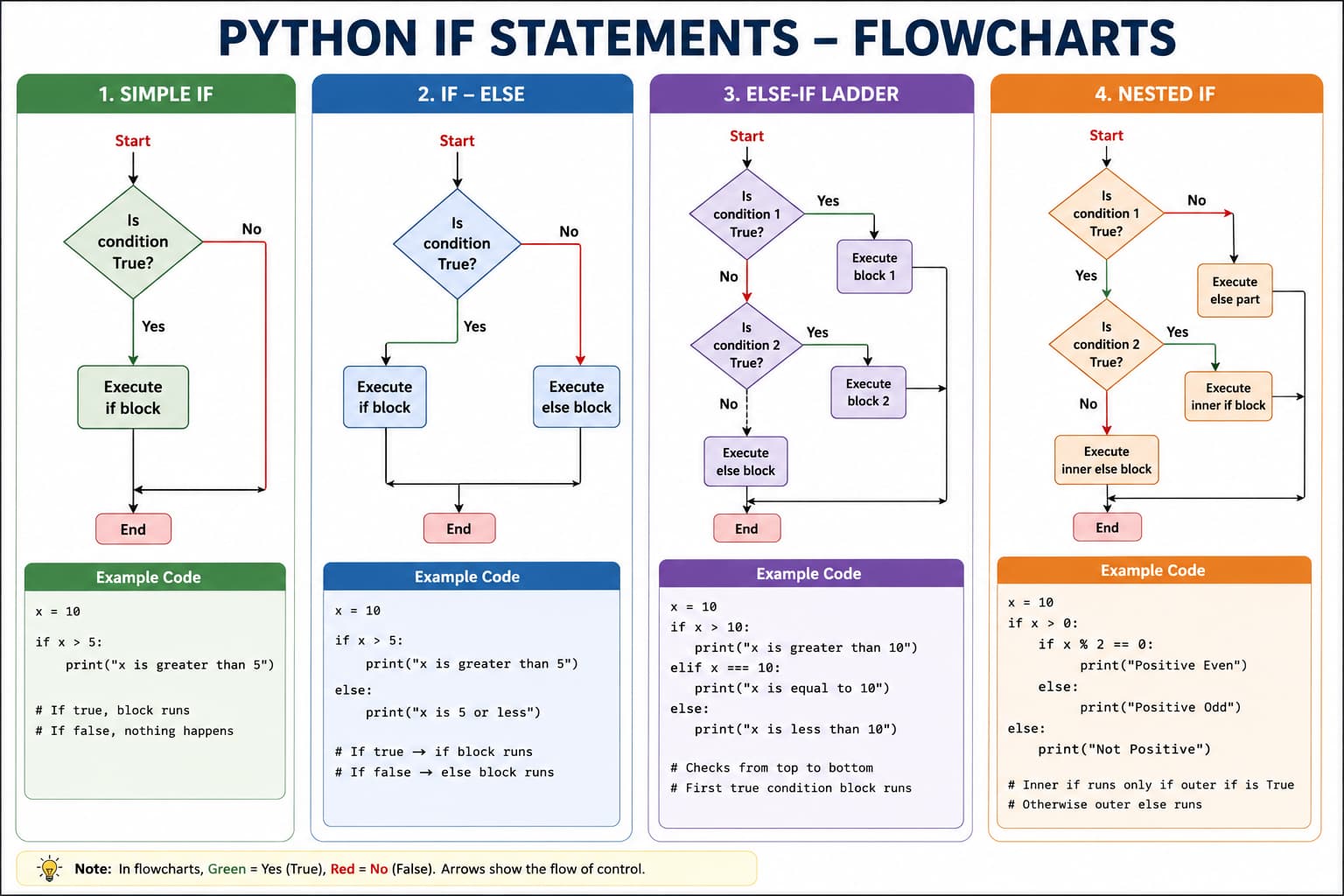
if, elif, and else structure decisions in Python.Key Concept
Conditional statements evaluate Boolean expressions (True or False) to decide which code blocks to execute. Python uses indentation (whitespace) to define code blocks.
# General syntax of conditional statements
if condition:
    # Code to execute if condition is True
    statement1
    statement2
elif another_condition:  # Optional (multiple can exist)
    # Code to execute if elif condition is True
    statement3
else:                    # Optional
    # Code to execute if all conditions are False
    statement4

# Note the colon (:) and indentation (4 spaces or 1 tab)
Python Conditional Statements Classification
Python conditional statements are classified into 4 main types. Each type serves a specific purpose in decision-making logic.
Complete Conditional Statements Reference Table
| Type | Syntax | Description | Best For | Example |
|---|---|---|---|---|
| Simple if | if condition: | Executes a block only when condition is True | Single condition check, execute or skip | if age >= 18: print("Can vote") |
| if-else | if-else | Provides two alternative execution paths | Two-way decisions, either-or scenarios | if score >= 50: pass else: fail |
| elif Ladder | if-elif-else | Checks multiple conditions sequentially | Multiple exclusive conditions, categorization | if grade=='A': elif grade=='B': else: |
| Nested if | if inside if | Conditional statements inside other conditionals | Hierarchical decisions, multi-stage validation | if condition1: if condition2: ... |
- Use simple if for single condition checks
- Use if-else for binary (true/false) decisions
- Use elif ladder when you have multiple exclusive conditions
- Use nested if for complex hierarchical decisions
Conditional Statement Examples with Output
Let's explore practical examples of each conditional statement type with actual Python code and output.
# Simple if Statement Examples
print("=== Simple if Statement ===")

# Example 1: Check if number is positive
number = 10
if number > 0:
    print(f"{number} is a positive number")

# Example 2: Check voting eligibility
age = 18
if age >= 18:
    print("You are eligible to vote!")

# Example 3: String condition
password = "secure123"
if len(password) >= 8:
    print("Password meets minimum length requirement")

# Example 4: Multiple conditions with AND
temperature = 25
humidity = 60
if temperature > 20 and humidity < 70:
print("Weather conditions are comfortable")# if-else Statement Examples
print("\n=== if-else Statement ===")
# Example 1: Even or odd number check
number = 7
if number % 2 == 0:
print(f"{number} is an even number")
else:
print(f"{number} is an odd number")
# Example 2: Age verification for movie ticket
age = 16
if age >= 18:
print("You can watch the movie (18+ rating)")
print("Ticket price: $12")
else:
print("Sorry, you are too young for this movie")
print("Please choose a different movie")
# Example 3: Password validation
entered_password = "admin123"
correct_password = "admin123"
if entered_password == correct_password:
print("Access granted!")
else:
print("Access denied!")# Short elif ladder example
marks = 82
if marks >= 90:
print("Grade A")
elif marks >= 75:
print("Grade B")
elif marks >= 60:
print("Grade C")
else:
print("Need improvement")# Short nested if example
age = 20
has_id = True
if age >= 18:
if has_id:
print("Entry allowed")
else:
print("ID required")
else:
print("Not eligible")Comparison and Best Practices
Different types of conditional statements are suitable for different scenarios. Here's a comparison to help you choose the right one.
| Type | Best For | When to Use | Complexity | Readability |
|---|---|---|---|---|
| Simple if | Single condition check | When you need to execute or skip a block | Low | High |
| if-else | Two alternative paths | Either-or decisions, pass/fail scenarios | Low | High |
| elif Ladder | Multiple exclusive conditions | When you have 3+ mutually exclusive options | Medium | Medium |
| Nested if | Hierarchical conditions | Multi-stage validation, complex logic | High | Low (if deeply nested) |
- Use meaningful condition names for better readability
- Avoid deeply nested if statements (more than 2-3 levels)
- Use logical operators (
and,or) to combine simple conditions - Always include a final
elseclause for handling unexpected cases - Use comments to explain complex conditional logic
Real-World Applications
Conditional statements are used everywhere in programming. Here are some practical applications:
E-commerce Discount System
Apply discounts based on order amount and user type:
if user_type == "premium":
    discount = 20
elif order_amount > 1000:
    discount = 15
elif order_amount > 500:
    discount = 10
else:
    discount = 5
Health Monitoring System
Check health metrics and provide recommendations:
if blood_pressure > 140:
    status = "High BP - Consult doctor"
elif blood_pressure < 90:
    status = "Low BP - Rest and hydrate"
else:
    status = "Normal - Keep monitoring"
Game AI Decision Making
AI character decisions based on game state:
if player_nearby:
    if player_health < 30:
        action = "attack"
    else:
        if ai_health > 70:
            action = "attack"
        else:
            action = "retreat"
else:
    action = "patrol"
Smart Home Automation
Control home devices based on conditions:
if time.hour > 18:
    if motion_detected:
        lights.on()
    else:
        lights.off()
elif temperature > 25:
    ac.on()
else:
    ac.off()
Practice Programs
Use these short practice programs to master each conditional type quickly.
# Program 1: Check if number is positive
num = -7
if num > 0:
print("Positive number")# Program 2: Even or odd
num = 24
if num % 2 == 0:
print("Even")
else:
print("Odd")# Program 3: Grade calculator
marks = 68
if marks >= 90:
print("A Grade")
elif marks >= 75:
print("B Grade")
elif marks >= 60:
print("C Grade")
else:
print("D Grade")# Program 4: Login access check
username = "admin"
password = "admin123"
if username == "admin":
if password == "admin123":
print("Login successful")
else:
print("Wrong password")
else:
print("Invalid username")Key Takeaways
- Simple if: Executes code only when condition is True
- if-else: Provides two alternative execution paths
- elif ladder: Handles multiple exclusive conditions sequentially
- Nested if: Places if statements inside other if statements for complex logic
- Python uses indentation (4 spaces) to define code blocks - this is mandatory
- Conditions are Boolean expressions that evaluate to True or False
- Use
and,or,notoperators to combine conditions - In elif ladders, order matters - conditions are checked top to bottom
- Avoid deep nesting (more than 2-3 levels) for better readability
- Always include an
elseclause for handling unexpected cases